Wykłady mistrzowskie
Obowiązek obecności na pięciu wykładach w ciągu roku; wykłady i seminaria gości odwiedzających różne instytuty Wydziału Neofilologii, Wydziału Filologicznego w ramach współpracy bilateralnej, programu Erasmus +, programu Visiting Professor, programu Pracowni Humanistyki Cyfrowej itp.; możliwe zaliczenie w innym kolegium (wybór w uzgodnieniu z promotorem, po akceptacji przez kierownika kolegium).
ROK AKADEMICKI 2025/2026
Październik
Prof. Sari Kivistö, „How to put an end to mortals’ bitter griefs with music and song? On poetry, sustainability, and dietetics”.
W ramach IDUBowego programu wizyt krótkich zapraszamy na wykład prof. Sari Kivistö z Tampere University (Finlandia). Wykład odbędzie się 13 października 2025 r., godz. 17:00, aula, Katedra Judaistyki
Temat wykładu: „How to put an end to mortals’ bitter griefs with music and song? On poetry, sustainability, and dietetics”.
Streszczenie: Euripides once said that it would be great happiness if one could improve one’s life by means of songs, but this is a mere wish that usually does not come true. However, since antiquity poets have helped to sustain living bodies by giving instructions on health, described herbs and treatments, and preserved traditional medical knowledge in poetic form. Poetry has been used as spells to banish evil spirits or cure epilepsy in ancient times (e.g., Icelandic spells). According to some early modern poets and physicians, poetry could preserve physical and mental health, because it could regulate passions and secure a good balance of the bodily fluids by lifting spirits. My presentation explores how the recreation of the body and the mind through poetry included dietetic aspects and was part of lifestyle modification in the long eighteenth century. To analyse this condition, I focus on medical knowledge and dietetic poetry written in Latin to illuminate the visceral qualities of poetry and its role in maintaining health. I am especially interested in poems that address health and nourishment and aim to sustain healthy bodies and life over time.
Notka bio: Sari Kivistö jest profesorką literatury porównawczej na Uniwersytecie w Tampere (Finlandia). Przez lata pracowała i kierowała Helsinki Collegium for Advanced Studies. Jest członkinią Finnish Academy of Science and Letters oraz Finnish Society of Sciences and Letters.
Jej liczne publikacje poświęcone są literaturze łacińskiej i nowołacińskiej, satyrze wierszowanej, medycynie w literaturze oraz cierpieniu i antyteodycei w literaturze.
Jest autorką następujących książek w języku angielskim:
- Critical Distance: Ethical and Literary Engagements with Detachment, Isolation, and Otherness (wraz z S. Pihlström, 2023),
- Neo-Latin Verse Satire, ca. 1500-1800. An Ethical Approach (2022),
- Lucubrationes Neolatinae. Readings of Neo-Latin Dissertations and Satires (2018),
- Kantian Antitheodicy. Philosophical and Literary Varieties (wraz z S. Pihlström, 2016),
- Death in Literature (red. wraz z O. Hakola, 2014),
- The Vices of Learning. Morality and Knowledge at Early Modern Universities (2014),
- Medical Analogy in Latin Satire (2009).
Prof. Marusya Bociurkiw, „Analogue Revolution: How Feminist Media Changed the World”.
Zakład Literatury i Kultury Amerykańskiej zaprasza na spotkanie z Marusyą Bociurkiw, kanadyjską pisarką, badaczką i reżyserką. Termin: 16 października 2025 (czwartek), godz. 16:00 – 18:15,
Instytut Filologii Angielskiej, sala 208
Abstrakt po angielsku: Prof. Marusya Bociurkiw will talk about her latest film. This feature-length documentary traces the rise and fall of analogue feminist communications that preceded the MeToo era. From Halifax to Vancouver, feminist storytellers of the 1970s to 1990s took hold of cutting-edge media technology to document everything from racism in the women’s movement, to how to insert a diaphragm. The film includes rare archival footage, like African American feminist poet Audre Lorde’s speech at the Third International Feminist Book Fair (Montreal 1988) and pro-choice demonstrations in the 1980’s, leading to the film’s climax: draconian cutbacks to women’s and lesbian organizations across Canada, following the massacre of women at École Polytechnique in Montreal, 1989. Cutbacks, racism, and moral panics then decimated an intricate, sophisticated, and world-changing feminist media movement. The film concludes with a resurgence and a сall to action: young BIPOC feminists using analogue strategies to create new feminist digital networks,
Notka bio: Marusya Bociurkiw (Boh-syer-kev) is a writer, curator, filmmaker and Professor Emeritus at Toronto Metropolitan University. She got her start as a filmmaker in the 1980’s experimental video/film movement and has since directed or co-directed eleven films and videos. She has published essays and articles in The Globe & Mail, Now Magazine, Xtra!, Rabble, The Canadian Journal of Communication, and many other academic and literary publications. Her 6 books, the most recent of which is Food Was Her Country: The Memoir of a Queer Daughter, span several genres and have won or been shortlisted for several awards. Her 2015 film, “This Is Gay Propaganda: LGBT Rights & the War in Ukraine” (2015) screened in 13 countries & was translated into four languages. Her latest film, the award-winning “Analogue Revolution: How Feminist Media Changed the World” examines the role of analogue technologies in feminism and social change. It was nominated for best documentary by the 2025 Canadian Screen Awards. From the recording and rewriting of family foodways to the auto-ethnographic examination of feminist video collectives in Canada – her work broadly concerns itself with the narrativizing of archives, and their corrective role in national memory.
Organizatorzy: dr hab. Mateusz Świetlicki, prof. UWr; dr hab. Katarzyna Nowak-McNeice, prof. UWr; mgr Anna Kobylowska
Prof. Pieter Vermeulen ,,The Anthropocene: A Literary Career”.
Wykład pt. „The Anthropocene: A Literary Career”, prof. Pieter Vermeulen (KU Leuven):
https://www.arts.kuleuven.be/english/our-staff/zap/pietervermeulen
Termin: 20 października (poniedziałek), godz. 12:00 (ok. 50 minut plus dyskusja), Katedra Judaistyki, s. 115 (aula)
Streszczenie: Wykład otwarty pt. “The Anthropocene: A Literary Career” poświęcony będzie popularności, jaką cieszy się w ostatniej dekadzie w badaniach humanistycznych (w tym literaturoznawczych) koncepcja antropocenu. Wykład będzie czerpał m.in. z badań opisanych w monografii prof. Vermeulena pt. Literature and the Anthropocene, która ukazała się nakładem wyd. Routledge w 2020 roku.
Notka bio: Pieter Vermeulen jest profesorem nadzwyczajnym literatury amerykańskiej i porównawczej na Uniwersytecie KU Leuven – jednej z kilkunastu najlepszych uczelni w Europie według większości rankingów. Zajmuje się literaturą współczesną, teorią literatury, pojęciem literatury światowej oraz koncepcją antropocenu. Autor ponad 90 publikacji naukowych, w tym trzech monografii: Geoffrey Hartman: Romanticism after the Holocaust(Continuum, 2012), Contemporary Literature and the End of the Novel: Creature, Affect, Form (Palgrave Macmillan, 2015) i Literature and the Anthropocene (Routledge, 2020). Prof. Vermeulen jest również współredaktorem dziesięciu tomów zbiorowych i numerów specjalnych czasopism, m.in. na temat metod i form literatury światowej („Institutions of World Literature”, opublikowany przez Routledge) oraz literatury współczesnej i koncepcji archiwum (podwójne wydanie specjalne czasopisma „LIT: Literature Interpretation Theory”). Jego artykuły ukazały się w czasopismach takich jak „Anglia”, „Arcadia”, „Criticism”, „Critique”, „Cultural Critique”, „Genre”, „Literature Compass”, „Journal of Modern Literature”, „Memory Studies”, „Modern Fiction Studies”, „Mosaic”, „Parallax”, „Poetics Today”, „Political Theory”, „Studies in the Novel” i „Textual Practice”. Prof. Vermeulen jest jednym z najczęściej cytowanych europejskich literaturoznawców. Ma on obecnie 1671 cytowań indeksowanych w bazie Google Scholar oraz h-index o wartości 20.
Organizacja wykładu: dr hab. Wojciech Drąg, prof. UWr
Wydział Neofilologii oraz Wydział Filologiczny Uniwersytetu Wrocławskiego serdecznie zapraszają na wykłady naukowe zagranicznych gości przyjeżdżających w ramach programu IDUB na zaproszenie dr hab. Justyny Bajdy, prof. UWr (IFP, WF) dr hab. Doroty Michułki, prof. UWr (IFP UWr) i dr. hab. Mateusza Świetlickiego, prof. UWr (IFA, WN). Wydarzenie będzie miało miejsce 22 października 2025 roku w Instytucie Filologii Polskiej Uniwersytetu Wrocławskiego przy pl. Nankiera 15b, w sali Nehringa (s. 22).
W ramach inicjatywy IDUB zaplanowano trzy wykłady:
Wykład pt. Captivated by the Text: Cognitively Challenging Picturebooks and Inclusive Education, o godz. 9.15 wygłosi prof. Åse Marie Ommundsen (Oslo Metropolitan University, Norwegia); Profesor zapraszający: dr hab. Mateusz Świetlicki, prof. UWr (Instytut Filologii Angielskiej, Wydział Neofilologii)
Bio po angielsku: Åse Marie Ommundsen is Professor of Scandinavian literature in the Faculty of Education and International Studies at Oslo Metropolitan University (OsloMet), Norway. Her interest in children’s literature, multimodal texts and picturebooks for adults has fostered numerous publications as well as guest lectures and keynotes. She is the author of several books, book-chapters, and international journal articles in Norwegian, Danish, English, French, Persian, and Dutch. Ommundsen is the editor of Looking Out and Looking In: National Identity in Picturebooks of the New Millennium (Novus 2013) and coeditor of Exploring Challenging Picturebooks in Education: International perspectives on language and literature learning (with Gunnar Haaland and Bettina Kümmerling-Meibauer, Routledge 2022), among others. She has served for two years in the Arts Council Norway and in the Brage Prize Jury. In 2013, she was awarded the Kari Skjønsberg Award for her research on children’s literature. She chairs the research group Challenging Picturebooks in Education and the research project Inclusive Learning with Challenging Picturebooks.
Abstrakt po angielsku: Why do we read? How does a book entice or enlist us? How does a song surprise or seduce us? What characterizes the aesthetic experiences of feeling captivated by works of art? How do you choose the right book that arouses interest, challenges cognitively, stimulates curiosity and promotes inclusive education? The lecture opens with a read aloud of a book that challenges the reader cognitively, stimulates the reader’s curiosity and engages the reader in an active meaning making process. The reader becomes co-author, actively constructing meaning from textual transactions across a range of modes – visual, spatial, and textual. The choice of books is decisive for the joy of reading for children, young adults and adults alike. In the lecture Ommundsen presents recent research on how picturebook projects with carefully selected, high-quality picturebooks carried out in schools foster inclusive learning communities in which all students can participate on equal terms. She discusses how the challenging picturebook communicates and how to include all students in the class in a shared, simultaneous aesthetic experience.
Wykład pt. It’s the Teacher, Not the Book: Rethinking the Role of Literature in Intercultural Education, o godz. 10.10 wygłosi prof. Xavier Mínguez-López (University of Valencia, Hiszpania); Profesor zapraszający: dr hab. Dorota Michułka, prof. UWr (Instytut Filologii Polskiej, Wydział Filologiczny)
Bio po angielsku: He is an associate professor at the University of Valencia (Faculty of Teacher Training) and a member of ERI-Lectura (research centre). He holds a PhD in Literary and Language Education and a degree in Catalan Philology. His research focuses on children’s and young adult literature, literary competences, intercultural education, and the use of media in literary education. He has published several articles in indexed international journals, such as Animation, Bookbird, Intercultural Education, Marvels and Tales, Ikala, and Literacy, on topics such as socio-cultural gender, multiculturalism, literary theory and educational practices, and children’s literature theory and criticism. The subject of his doctoral thesis was interculturalism (Extraordinary Doctoral Award). He was a scholarship holder at the National University of Yokohama (Japan 2001–2002), the University of Roehampton (2011), the International Youth Library (2018), and Harvard University (2025). He has also led educational cooperation projects in Mali, El Salvador, Guatemala, Honduras and Colombia, focusing in particular on teacher training. As part of his recent research, in collaboration with Harvard lecturers, he is investigating the real impact of children’s books on intercultural competence. He collaborates with researchers from Europe and Latin America and is co-editor of the international Journal of Literary Education. As an author of children’s books, he has received numerous awards.
Abstrakt po angielsku: This intervention explores the role of teachers in fostering intercultural competence through multicultural picturebooks in primary education. Based on a pilot study in two Spanish schools with contrasting sociocultural contexts, 86 students aged 8–9 participated in guided readings and discussions of six multicultural picturebooks over three months. Using the Intercultural Competence Assessment for Primary Education (CIAP) alongside qualitative classroom analysis, the study found that reading multicultural books alone does not significantly improve intercultural competence.The findings reveal that teacher mediation is the decisive factor shaping students’ interpretations and attitudes toward diversity. In the homogeneous, upper-middle-class school, students viewed cultural difference as distant or even unsettling, reflecting the teacher’s color-blind and normative discourse. Conversely, in the multicultural school, the teacher’s inclusive approach—connecting stories to students’ lived experiences and national history—enabled genuine empathy and critical reflection. The study concludes that literature can only promote intercultural understanding when teachers are equipped to engage in open, reflective dialogue about diversity. Effective intercultural education thus requires not only diverse materials but also pedagogical training that empowers teachers to transform reading into meaningful intercultural encounters.
Wykład pt. Migrants, Nomads and Identity in Children’s Literature, o godz. 11.05 wygłosi prof. Georgia (Tzina) Kalogirou (National and Kapodistrian University of Athens, Grecja); Profesor zapraszający: dr hab. Justyna Bajda, prof. UWr (Instytut Filologii Polskiej, Wydział Filologiczny)
Abstrakt po angielsku: This research explores the multifaceted representation of mobility, migration, and geographical displacement within contemporary children’s literature, arguing that these narratives are critical sites for negotiating young subjectivities in an increasingly globalized world. This strand of inquiry specifically examines the figures of the migrant and the nomad in fiction, analyzing how textual strategies are deployed to construct, contest, and destabilize notions of identity and belonging tied to fixed geographical locations. By analyzing narrative frameworks surrounding movement and rootlessness, this presentation demonstrates how children’s texts engage with the complexities of modern human movement and the fluid nature of selfhood. Ultimately, this work seeks to establish a renewed critical framework for analyzing how literature for young readers addresses the shifting relationship between self, text, and place.
Bio po angielsku: Georgia (Tzina) Kalogirou is Associate Professor in the School of Humanities/Department of Pedagogy and Primary Education at the National and Kapodistrian University of Athens, specializing in Modern Greek Literature and its Didactics. She is the Director of the Interdepartmental Postgraduate Programme Rhetoric, Human Sciences, and Education (Department of Pedagogy and Primary Education, NKUA – Department of Early Childhood Education, University of Western Macedonia), which has been re-established under the title Rhetoric, Communication, and Creative Writing in Education. She also directs the Postgraduate Programme of the School of Humanities, titled ‘Social Sciences and Humanities in Education’. She has served as Deputy Chair of the Department of Primary Education (2019–2020 and 2024–2025) and as Head of the School of Humanities (2021–2022 and currently). Additionally, she serves as Director of the Laboratory for Applied Linguistics, Literary, and Rhetorical Studies. She is the author, editor, or co-editor of books (in Greek and English) and numerous chapters/papers (in Greek, English, French, and Italian) in edited volumes, international and national journals, and conference proceedings. She is a member of the scientific and organisational committees of the cyclical international conference The Child and the Book and editor-in-chief (together with Xavier Minguez Lopez) of the international „Journal of Literary Education”. She is also an official partner of the international research project TALIS, implemented within the Memită network: Memory, Identity, Integration to Identify Analysis Mode/s in Media Communication, which includes researchers from 20 universities around the world. She is also a member of the scientific committees of the ‘Laboratorio Children’s Books’ publishing series, published by the prestigious publishing house Anicia Edizioni-Rome, Niata, and a member of the international scientific committee of Triskeles. Collana mediterranea di storia, letteratura e varia umanistica. The latest works published under the editorship of Prof. Kalogirou are The Silver School Bag. Creative teaching approaches for the Literary Classroom (2024) and Aspects of Time and Memory in Literature for Children and Young Adults: Mnemosyne for Children (Cambridge Scholar 2024) (with Dorota Michułka).
Organizatorzy: dr hab. Mateusz Świetlicki, prof. UWr; dr hab. Dorota Michułka, prof. UWr; dr hab. Justyna Bajda, prof. UWr
Prof. Aleksandra Nowakowska „Comment le dialogisme révèle-t-il l’épaisseur du discours? Outils de l’analyse du discours”.
Instytut Filologii Romańskiej zaprasza na wykład profesor Aleksandry Nowakowskiej (językoznawczyni reprezentującej Université Paul-Valéry Montpellier 3 we Francji), która odwiedzi nasz Uniwersytet w ramach programu IDUB – visiting professor. Wykład pt. „Comment le dialogisme révèle-t-il l’épaisseur du discours? Outils de l’analyse du discours’’ odbędzie się w dniu 22.10.2025 (środa), godz. 12:00-13:30, Instytut Filologii Romańskiej, s. 3.2 (forma stacjonarna).
Język wykładu – język francuski
Résumé : Issu de travaux de cercle de Bakhtine (1934/78, 1952/84, 1963/70), le dialogisme est un des concepts clés en analyse du discours. Il correspond à l’orientation de tout discours, constitutive et au principe de sa production comme de sa réception, (i) vers des discours réalisés antérieurement sur le même objet, (ii) vers le discours-réponse qu’il sollicite, (iii) vers lui-même en tant que discours.
Cette intervention se propose de répondre à la question de « comment le dialogisme révèle-t-il l’épaisseur du discours ? », posée dans le titre, en s’appuyant sur l’analyse de plusieurs types de discours, notamment politique, militantiste écologique, médiatique, littéraire ou encore conversationnel. Après avoir explicité le potentiel heuristique de cette notion, il sera question de la mettre à l’épreuve des corpus, afin de montrer la manière dont un discours tisse des interactions avec d’autres discours et en quoi ce tissage révèle une multitude de voix et points de vue qui le traversent.
Notka bio: Aleksandra Nowakowska – językoznawca, profesor Uniwersytetu Paul-Valéry Montpellier 3 we Francji, od 2015 roku członek (z wyboru) Rady laboratorium badawczego Praxiling (UMR 5267, CNRS), w latach 2022-2024 – dyrektor Departamentu Nauki o Języku (Département des Sciences du langage). Specjalizuje się w językoznawstwie wypowiadania i analizie dyskursu, a zwłaszcza w teorii dialogiczności inspirowanej pracami Michaiła Bachtina. Autorka lub współautorka kilkudziesięciu publikacji, w tym uznanej monografii Petite grammaire alphabétique du dialogisme (Garnier, 2019), będącej owocem dwudziestoletnich studiów nad dialogicznością, oraz licznych artykułów w czasopismach międzynarodowych (m.in. Bergen Language and Linguistics Studies, Le français moderne, Cahiers de praxématique, Le Discours et la langue, Information grammaticale). Kierownik finansowanego przez Europejski Fundusz Rozwoju Regionalnego projektu „Aphasie et Analyse du Discours en Interaction: constitution de bases de données et nouvelles méthodes d’exploitation (AADI)” (2019-2022), w ramach którego powstały innowacyjne narzędzia do analizy wypowiedzeń osób z zaburzeniami mowy. Regularnie występuje jako prelegentka na międzynarodowych konferencjach naukowych poświęconych językoznawstwu. Jest wieloletnią ekspertką prestiżowego Światowego Kongresu Językoznawstwa Francuskiego (Congrès Mondial de Linguistique Française).
Osoba odpowiedzialna ze strony organizatora: dr Patrycja Paskart, Instytut Filologii Romańskiej, patrycja.paskart@uwr.edu.pl
Prof. dr. dr. dr. h.c. Ernest Hess-Lüttich ,,Stadt-Zeichen: Interkulturelle Sprachlandschaften in urbanen Räumen”.
Zakład Lingwistyki Stosowanej IFG UWr zaprasza na wykład w ramach profesury gościnnej IDUB prof. dr. dr. dr. h.c. Ernesta Hess-Lütticha z Uniwerystetu Technicznego w Berlinie, w dniu 22.10.2025, godz. 14.00-15.30, pl. Nankiera 15B, s. 26, Wydział Filologiczny
Tytuł wykładu: Stadt-Zeichen: Interkulturelle Sprachlandschaften in urbanen Räumen
Język wykładu – język niemiecki
Abstract
Wykład „Stadt-Zeichen: Interkulturelle Sprachlandschaften in urbanen Räumen” podejmuje refleksję nad fenomenem wielojęzycznych krajobrazów językowych w przestrzeni miejskiej. Analiza semiotyczna i socjolingwistyczna znaków obecnych w przestrzeni publicznej (szyldy, afisze, graffiti, tablice informacyjne) pozwala uchwycić dynamikę procesów migracyjnych, globalizacyjnych i interkulturowych, które współkształtują tożsamość współczesnych metropolii. Szczególny nacisk zostanie położony na funkcje komunikacyjne i symboliczne języka w przestrzeni miejskiej oraz na mechanizmy negocjowania znaczeń w kontaktach międzykulturowych. Dyskusja zostanie osadzona w kontekście europejskich przykładów, ze wskazaniem na rolę krajobrazu językowego jako pola badań nad polityką językową, integracją społeczną i widocznością mniejszości w przestrzeni publicznej.
Notka bio
Ernest W.B. Hess-Lüttich (*1949), Ordinarius emeritus (Germanistik: Sprach- u. Literaturwiss.) Univ. Bern (CH) [1991-2014], Hon.Prof. (Allg. Linguistik) TU Berlin (D) [seit 2015], Hon.Prof. (German Studies) Stellenbosch Univ. (ZA) [2007-2017] u. University of Cape Town (ZA) [seit 2020], Gastprof. MHB Fontane (D) [seit 2016]; Dr. phil. (Philologien), Dr. paed. (Sozialwiss.), Dr. habil (Germanistik u. Allg. Linguistik), Dr. h.c. [Budapest 2009]; akad. Werdegang: Lektor in German London Univ. [1970-72], Tutor U Bonn [1972-74], Wiss.Ass. Anglistik TU Braunschweig [1974-75], Wiss.Ass. Germanistik FU Berlin [1975-80], Priv.Doz. Dt. Philologie + Allg. Linguistik Bonn/Berlin [1985-90], Full Prof. German Studies, Assoc. Prof. Comparative Literature, Research Fellow Semiotics IU Bloomington [1990-92]; Forschungsschwerpunkte: Diskurs- u. Dialogforschung (soziale, literarische, ästhetische, intermediale, interkulturelle, intra-/subkulturelle, institutionelle, fachliche, öffentliche, politische, urbane Kommunikation); Publikationen: ca. 70 Bücher u. Editionen sowie ca. 400 Aufsätze; Monographien u.a. zur Dialoglinguistik, Kommunikation i. d. Literatur, Semiotik d. Dramas u. Theaters, Grammatik d. dt. Sprache, Literaturtheorie u. Medienpraxis, Urbane Sprachlandschaften; Herausgeberschaften: div. Zeitschriften u. Buchreihen, u.a. Kodikas/Code. Int’l. Journ. of Semiotics u. Kodikas Supplement Series [seit 1979], Cross Cultural Communication [seit 1994], Zs. f. interkulturelle Germanistik [bis 2015]; Fachgesellschaften: Dt. Ges. f. Semiotik (Präsident, jetzt Ehrenmitglied), Ges. f. Angewandte Linguistik (Vizepräsident), Int’l. Assoc. of Dialogue Analysis (Vizepräsident), Ges. f. interkulturelle Germanistik (Präsident, jetzt Ehrenmitglied); Mitglied div. Advisory Boards u. Editorial Boards; Ehrenmitglied d. Ges. ungarischer Germanisten, Mitglied d. Wiss. Beirates d. ICLTT d. Österreichischen Akademie der Wissenschaften [bis 2016]; Gastprofessuren: München, Graz, Madison, Gainesville, Belo Horizonte, New York, Puerto Rico, New Delhi, Basel, Izmir, Bangkok, Stellenbosch, Melbourne, Ambon u. Visiting Scholar an ca. 20 weiteren Universitäten in Europa, Amerika, Afrika, Asien, Australien.
Organizacja wykładu: prof. dr hab. Joanna Szczęk
Dr hab. Mikołaj Deckert „Gra wideo w przekładzie: czy napisy mają znaczenie?”
Zakład Translatoryki Instytutu Filologii Angielskiej oraz Koło Naukowe Groznawców Fire Keepers zaprasza na wykład dr. hab. Mikołaja Deckerta pt. Gra wideo w przekładzie: czy napisy mają znaczenie? Wykład odbędzie się 23 października o 13:00 na platformie MS Teams. Wykład i dyskusja odbędą się w języku polskim.
Link do spotkania:
https://teams.microsoft.com/meet/3132457148406?p=qd6Q3Az825hyo3Bpxb
Streszczenie:Wykład koncentruje się na przekładzie gier wideo w ujęciu recepcyjnym. Punktem wyjścia jest obserwacja, że badania poświęcone tematyce tłumaczenia gier w zdecydowanie niedostatecznym stopniu wykorzystywały dotąd dane pochodzące od użytkowników takich produktów (por. Mangiron 2018, Deckert i in. 2024), chociaż badania nad innymi aspektami doświadczania gier są wysoce rozwinięte (por. Drachen i in. 2018). W referacie zaprezentowane zostaną wyniki eksperymentu, gdzie uczestnicy grali w grę, korzystając z polskojęzycznego tłumaczenia w formie napisów. Zasadniczym celem jest udzielenie odpowiedzi na pytanie, czy obniżenie jakości napisów (poprzez manipulację eksperymentalną) istotnie wpływa na wielowymiarowo rozumiane doświadczenie osób grających.
Notka bio: Dr hab. Mikołaj Deckert, prof. UŁ, pracuje w Instytucie Anglistyki Uniwersytetu Łódzkiego. Jego zainteresowania naukowe obejmują przekład, szczególnie audiowizualny, a także relacje pomiędzy językiem i procesami poznawczymi. Jest autorem monografii poświęconych zagadnieniom tłumaczenia gier wideo – „On-Screen Language in Video Games: a Translation Perspective” (CUP, 2022, z K. W. Hejdukiem) i „Towards Game Translation User Research” (CUP, 2024, z K. W. Hejdukiem i M. A. Bernalem-Merino) – oraz redaktorem m.in. tomów „The Palgrave Handbook of Audiovisual Translation and Media Accessibility” (Palgrave Macmillan, 2020, z Ł. Boguckim) i “User-Centric Studies in Game Translation and Accessibility” (Routledge, 2024, z K. W. Hejdukiem). Kieruje projektami badawczymi finansowanymi przez Narodowe Centrum Nauki: „Doświadczanie gier wideo w przekładzie: model recepcyjny”, „Placebo i nocebo dla tłumaczy: model poznania antycypacyjnego w produkcji przekładu” oraz „Język na ekranie w grach wideo: perspektywa recepcji przekładu”. Jest jednym z redaktorów w czasopiśmie „Journal of Specialised Translation”.
Organizacja wykładu: Adam Bilski, Instytut Filologii Angielskiej
Dr hab. Jan Waszink „Hugo Grotius: Father of International Law (400 Years of De jure belli ac pacis, 1625)”.
Zakład Dawnej Literatury Niderlandzkiej Katedry Filologii Niderlandzkiej, zaprasza na wykład badacza holenderskiego dr. hab. Jana Waszinka (Universiteit Leiden / Instytut Historii im. Tadeusza Manteuffla PAN), wizytującego Uniwersytet Wrocławski w ramach zapraszania „profesorów wizytujących” programu IDUB.
Wykład mistrzowski, w języku angielskim, pt. Hugo Grotius: Father of International Law (400 Years of De jure belli ac pacis, 1625) odbędzie się 23 października 2025 r. o godz. 17:00 w Saloniku Kulturalnym Biblioteki Uniwersyteckiej we Wrocławiu (ul. Fryderyka Joliot-Curie 12, 50-383 Wrocław).
Biogram
Dr hab. Jan Waszink (doktorat: Universiteit van Amsterdam, 2002, habilitacja: Instytut Historii im. Tadeusza Manteuffla PAN, Warszawa, 2024) to jeden z najwybitniejszych znawców myśli politycznej i filozoficznej Hugona Grocjusza (Hugo Grotius, 1583-1645), twórcy zasad prawa międzynarodowego. Jako neolatynista Jan Waszink opublikował liczne artykuły poświęcone kulturze klasycznej XVI- i XVII-wiecznych Niderlandów, w tym polityce, dyplomacji i poezji Złotego Wieku. Swoją dysertację, której promotorem był wybitny neolatynista niderlandzki prof. Christiaan Lambert Heesakkers, zatytułowaną The Politica of Justus Lipsius. Introduction, Edition, Translation, poświęcił teoriom politycznym wybitnego filozofa, twórcy teorii neostoicyzmu Justusa Lipsiusa (1547-1606).
Jan Waszink jest założycielem i redaktorem naczelnym serii Bibliotheca Latinitatis Novae (Leuven University Press, Belgia), w której opublikował m.in. naukowe tłumaczenie, wraz z komentarzami: Hugo Grotius, Annals of the War in the Low Countries. Edition, Translation and Introduction by J. Waszink, Leuven UP 2023, będące podstawą jego habilitacji . Był kierownikiem i/lub uczestnikiem międzynarodowych projektów naukowych, w tym holenderskiego grantu Nederlands Fonds voor Wetenschappelijk Onderzoek, NWO-VENI, Radboud Universiteit Nijmegen – projekt The Annales and Historiae by Hugo Grotius; projektu Mapping the Latin Enlightenment, University of Western Australia at Perth; a także projektu NCN Opus: Secularisation of the West: Tacitism from 16th-18th centuries. Jego liczba cytowań (stan na rok 2023): z oddzielnym uwzględnieniem autocytowań: 289 (Google Scholar) oraz 1165 (Academia.edu); indeks Hirscha: 9.
O wykładzie
In 1625, 400 years ago, the child prodigy (with 11 years a student in Leiden, with 15 years dr. juris) and later a famous author of works about political theory and law, Hugo Grotius (1583-1645), published the famous work De jure belli ac pacis (On the Law of War and Peace, Paris 1625). This work had, for the first time, clearly formulated the general rules on ocean waters; therefore Grotius was called “the father of international law”. His first attempt to this was Mare Liberum (The Free Sea, Leiden 1609), where he argued that the Portuguese and the Spanish were not the only nations “to rule” over world’s seas. From now on the Dutch, fighting against the Spanish imperium, had broken its monopoly position. This was the beginning of the Dutch Golden Age.
The Wrocław University Library is a perfect venue for this lecture, as here (in the Old Prints Department) a magnificent collection of books from the 16th and 17th century is to be found (more than 300.000 works; one of the biggest collections in Europe); among them also works of Grotius, even with a dedication of his own hand.
Organizatorzy: prof. dr hab. Stefan Kiedroń, Zakład Dawnej Literatury Niderlandzkiej KFN, Uniwersytet Wrocławski – IDUB, Biblioteka Uniwersytecka we Wrocławiu
Listopad
Prof. dr Khrystyna Dyakiv, „Krisendiskurse im Deutschen und Ukrainischen: Sprachliche Dynamiken seit dem russischen Angriffskrieg gegen die Ukraine”.
Instytut Filologii Germańskiej zaprasza na wykład w ramach profesury gościnnej IDUB UWr Prof. dr Khrystyny Dyakiv (Lwowski Uniwersytet Narodowy im. Iwana Franki).
Wykład mistrzowski pt. Krisendiskurse im Deutschen und Ukrainischen: Sprachliche Dynamiken seit dem russischen Angriffskrieg gegen die Ukraine odbędzie się 4.11.2025, 14.00-15.30, s. 205, Wydział Filologiczny, Pl. Nankiera 15 B.
Abstract
Rosyjska inwazja na Ukrainę wywarła głęboki wpływ na dyskurs publiczny i sposoby wyrażania się w obu przestrzeniach językowych – niemieckiej i ukraińskiej. W wykładzie analizuję, jak od 2022 roku kształtują się dyskursy kryzysowe w języku niemieckim i ukraińskim oraz jakie środki językowe służą interpretacji, emocjonalizacji i ramowaniu wojny. Szczególną uwagę poświęcam nowym zjawiskom leksykalnym, metaforyce oraz zmianom w komunikacji medialnej. Na podstawie kontrastywnego korpusu obejmującego materiały prasowe, przemówienia polityczne i wpisy w mediach społecznościowych pokazuję, w jaki sposób język uczestniczy w konstruowaniu solidarności, oporu i tożsamości zbiorowej. Porównanie ujawnia zarówno odmienne strategie komunikacyjne, jak i wspólne tendencje w językowym radzeniu sobie z doświadczeniem wojny i kryzysu. Celem wystąpienia jest ukazanie dynamiki współczesnych dyskursów kryzysowych oraz ich znaczenia dla odporności społecznej i komunikacji politycznej.
Biogram
Ponad 100 publikacji naukowych, w tym 100 artykułów naukowych i rozdziałów w tomach zbiorowych, członkini Międzynarodowej Rady Naukowej Instytutu Języka Niemieckiego w Mannheim, członkini towarzystw naukowych: IVG, Arbeitsgemeinschaft fur Linguistische Pragmatik, Mitteleuropăischer Verbandes der Germanisten, sekretarz i skarbnik Unkraińskiego Stowarzyszenia Germanistów i Nauczycieli Języka Niemieckiego, członkini Unkraińskiego Stowarzyszenia Germanistów i Nauczycieli Języka Niemieckiego, oraz Internationaler Deutschlehrer- und Germanistenverbandes, beneficjentka wielu 06/2025 programów stypendialnych: 01/2025 — Comenius International Partnership Program, Siegen, MSCA4Ukraine-Stipendium am IDS Mannheim, 07/2023 DAAD-Stipendium am IDS Mannheim, 12/2024 Stipendiatin des Leibniz-lnstituts fijr Deutsche Sprache, Mannheim (IDS), 04/2023 Hanns-Seidel-Stiftung-Stipendium am Leibniz-lnstitut fur Deutsche Sprache, Mannheim (IDS), 2019, 2018, 2017, Hanns-Seidel-Stiftung-Stipendium am IDS Mannheim, 2016 Hanns-Seidel-Stiftung-Stipendium in Erlangen — Nürnberg, 2015 Hanns-Seidel-Stiftung Stipendium an der Universităt Bamberg, 2008 Hanns-Seidel-Stiftung-Stipendium an der Uni Erlangen—Nürnberg
Osoba odpowiedzialna: prof. dr hab. Joanna Szczęk
Prof. Anastasiia Lepetiukha, „Synonymie syntaxique dans la prose française des XXe ‒ XXIe siècles : théorie et pratique”.
Zakład Językoznawstwa Francuskiego UWr zaprasza na wykład mistrzowski prof. Anastasii Lepetiukhy z Narodowego Uniwersytetu Pedagogicznego im. Hryhorija Skoworody w Charkowie (Ukraina)
Zapraszamy do Instytutu Filologii Romańskiej (plac bpa Nankiera 4) w środę 19 listopada w godzinach 10.15 – 11.45. Wykład, prowadzony w języku francuskim, odbędzie się w sali 2.2. (pierwsze piętro).
Tytuł wykładu: Synonymie syntaxique dans la prose française des XXe ‒ XXIe siècles : théorie et pratique
Streszczenie wykładu:
Dans cette recherche, des constructions mono-, bi- et polysynonymiques sont considérées comme des transformants réduits, redondants et quantitativement équacomponentiels mono- et polytransfomationnels des syntagmes et propositions primaires virtuels (linguistiques), inversement reconstruits (discours → langue), à l’intérieur d’un ou de plusieurs macrochamps sémantico-fonctionnels de la synonymie syntaxique et s’actualisent sous forme de structures co(n)textuellement (linguistiquement et / ou situationnellement) pertinentes grammatisées ou agrammatisées en fonction de l’intention communicationnelle, des stratégies ludiques et des particularités idiostylistiques auctoriales. Elles se caractérisent par la préservation ou le changement du régime linguistique de l’incidence dans le discours. Certains types de syntagmes et énoncés synonymiques représentent le résultat d’un jeu linguistique uni- ou bilatéral double en vue de faciliter ou de complexifier au récepteur l’interprétation de l’information. La pertinence co(n)textuelle de chaque membre de la chaîne synonymique est déterminée par la voie de l’expérience linguistique « alternative » qui peut échouer en cas d’insuffisance d’expression intra- et interphrastique.
Biogram prof. Anastasii Lepetiukhy:
Anastasiia Lepetiukha jest romanistką zatrudnioną w Katedrze Językoznawstwa Ogólnego oraz Filologii Romańskiej i Germańskiej Narodowego Uniwersytetu Pedagogicznego im. Hryhorija Skoworody w Charkowie. Opublikowała kilka monografii oraz około 60 artykułów naukowych w czasopismach ukraińskich i zagranicznych. W swoich pracach bada mechanizmy tworzenia sensu we współczesnej prozie francuskiej. Interesuje się tym, jak struktura składniowa, semantyczna i pragmatyczna wpływa na spójność, ekspresję emocji i styl wypowiedzi. Jej teksty łączą podejście lingwistyczne, semantyczne i semiotyczne, a także wykazują zainteresowanie dydaktyką języka francuskiego jako obcego. Podejmuje ona w szczególności takie zagadnienia, jak synonimia składniowa (różne sposoby wyrażania tej samej treści poprzez odmienne konstrukcje gramatyczne), kompresja, elipsa i transformacje składniowe jako środki tworzenia znaczeń w tekście, organizacja tematyczno-rematyczna (sposób rozkładu informacji w zdaniu i dyskursie), relacje referencyjne i polifonia dyskursywna (wielogłosowość wypowiedzi), innowacje dyskursywne i indywidualny styl wybranych autorów francuskiej prozy XX–XXI w.
Profesor Anastasiia Lepetiukha przyjeżdża na Uniwersytet Wrocławski w ramach umowy bilateralnej. Organizatorem spotkania jest dr hab. Witold Ucherek, prof. UWr (witold.ucherek@uwr.edu.pl).
Prof. Silvia Adler, „Texte et image en action et en interaction : processus de construction de sens dans la BD franco-belge”.
Zakład Językoznawstwa Francuskiego UWr zaprasza na wykład mistrzowski prof. Silvii Adler z Uniwersytetu Bar-Ilan (Izrael)
Zapraszamy do Instytutu Filologii Romańskiej (plac bpa Nankiera 4) we wtorek 25 listopada w godzinach 15.45 – 17.15. Wykład, prowadzony w języku francuskim, odbędzie się w sali 3.2. (drugie piętro).
Tytuł wykładu:
Texte et image en action et en interaction : processus de construction de sens dans la BD franco-belge
Streszczenie wykładu:
Cette communication se propose d’introduire quelques principes fondamentaux de la grammaire de la bande dessinée, en tant que système de production du sens. On évoquera d’abord les principaux « piliers » de ce langage – le texte, l’image et leurs interactions – avant d’aborder la syntaxe propre à la bande dessinée, fondée sur les relations entre vignettes et la construction de la continuité narrative. Il s’agira également d’éveiller l’attention sur certaines dimensions sémiotiques et rhétoriques du médium : les modes de signification, et les procédés par lesquels la bande dessinée organise un discours capable d’émouvoir, de convaincre ou de faire réfléchir. Ces considérations seront illustrées à partir d’exemples issus de la bande dessinée franco-belge.
Biogram prof. Silvii Adler:
Profesor Silvia Adler jest językoznawczynią specjalizującą się w semantyce, składni i pragmatyce języka francuskiego oraz w analizie tekstów multimodalnych. Jej badania koncentrują się na elipsie, anaforze, przyimkach, nazwach ogólnych, intensywności i precyzji językowej. Jest autorką bądź współautorką ponad 50 artykułów opublikowanych w prestiżowych czasopismach oraz ponad 30 rozdziałów w monografiach, a także redaktorką kilku numerów czasopism i tomów naukowych, m.in. na temat niedookreśloności, sloganów reklamowych i języka komiksu. Opublikowała monografię Ellipse et Régimes des Prépositions Françaises (2012), uznaną za przełomową w opisie francuskich konstrukcji przyimkowych. Prowadziła badania w ramach grantów międzynarodowych, m.in. dotyczących dokumentacji historii życia frankofonów w Izraelu. Jest laureatką francuskiego odznaczenia Ordre des Palmes académiques (2019) oraz Nagrody Innowacji AFLS (2015). Była profesorem wizytującym na uczelniach we Francji, Włoszech, w Niemczech i na Węgrzech. Kierowała programami studiów magisterskich z zakresu analizy dyskursu oraz pełniła liczne funkcje akademickie i eksperckie w Izraelu i Europie. Jest promotorką prac doktorskich i magisterskich, aktywną członkinią wielu komitetów i rad naukowych oraz recenzentką w wiodących czasopismach z zakresu językoznawstwa.
Wykład odbędzie się w ramach programu visiting professor (IDUB), a organizatorem spotkania jest dr hab. Witold Ucherek, prof. UWr (witold.ucherek@uwr.edu.pl).
Prof. Maryna Vardanian, „Exploring Nature in Ukrainian Children’s Literature: Environmental Stories and Chornobyl Memory”.
Centrum Badań Literatury dla Dzieci i Młodzieży zaprasza na trzydziesty pierwszy wykład z serii „International Voices International Voices in Children’s Literature Studies”. Wykład prof. Maryny Vardanian (Kryvyi Rih State Pedagogical University/Heidelberg University), pt. „Exploring Nature in Ukrainian Children’s Literature: Environmental Stories and Chornobyl Memory” odbędzie się on-line 25 listopada o godz. 16.00 (TEAMS)
Wszystkich zainteresowanych udziałem prosimy o kontakt za pomocą formularza: https://forms.office.com/e/k83vY65RSn
Exploring Nature in Ukrainian Children’s Literature: Environmental Stories and Chornobyl Memory
Abstrakt po angielsku: How do Ukrainian children’s books tell stories of nature, memory, and identity? This lecture explores narratives from environmental tales to Chornobyl-inspired literature, showing how young readers encounter human–nature connections, ecological resilience, and Ukraine’s collective memory across the 20th and 21st centuries.
Bio po angielsku: Dr. Maryna Vardanian is a Professor at the Department of Translation and Slavic Studies at Kryvyi Rih State Pedagogical University (Ukraine). Since 2022, she has been a visiting scholar at the Institute for Translation and Interpreting, Heidelberg University (Germany), where her current research focuses on Ukrainian children’s literature and translation across the dimensions of identity, ideology, cultural memory, and emigration. Her main research interests include Ukrainian diasporic and contemporary children’s literature, cultural memory, and ecocriticism. She has authored more than 80 publications and is an active member of several academic societies.
Organizatorzy z ramienia Centrum Badań Literatury dla Dzieci i Młodzieży: dr hab. Mateusz Świetlicki, prof. UWr (Instytut Filologii Angielskiej), dr Elżbieta Jamróz-Stolarska (Instytut Nauk o Informacji i Mediach), dr Bożena Hojka (Instytut Nauk o Informacji i Mediach)
Grudzień
Prof. dr hab. Kamila Budrowska, „Jak czytać teksty opublikowane pod cenzurą? Literatura 1945-1990”.
Pracownia Kultury Literackiej XX w. Instytutu Filologii Polskiej zaprasza na wykład gościnny Prof. dr hab. Kamili Budrowskiej.
Tytuł: Jak czytać teksty opublikowane pod cenzurą? Literatura 1945-1990
Termin: 2 XII, godz. 12.00
Miejsce: Sala Nehringa, IFP UWr
Abstrakt: Historyczka literatury charakteryzuje cenzorską teorię; dzieli kwestionowanie tekstów ze względu na treść i ze względu na autorstwo. Klasyfikuje zatrzymanie publikacji jako jeden z typów cenzorskiej ingerencji. Bada zatrzymane przez cenzurę inedita z połowy XX wieku. Analizuje m.in. obraz historii Polski w literaturze lat 1948-1958 jako przeszłość ocenzurowaną. Ukazuje zastosowania literatury przez cenzurę PRL (na podstawie cenzorskich materiałów instruktażowych). Identyfikuje strategie radzenia sobie z cenzurą i balansowania między przystosowaniem się do niej a oporem.
Notka bio: Prof. dr hab. Kamila Budrowska początkowo pracowała w Zakładzie Bibliotekoznawstwa, a po rozwiązaniu w 2003 tej jednostki – w Zakładzie Literatury Międzywojennej i Współczesnej. Prowadziła zajęcia na kierunku informacja naukowa i bibliotekoznawstwo oraz na polonistyce. W 2003, korzystając ze stypendium Fundacji na rzecz Nauki Polskiej, badała pod kierunkiem prof. Aliny Brodzkiej-Wald (IBL PAN) archiwa autorskie zachowane w Muzeum Literatury im. A. Mickiewicza w Warszawie. W tym samym okresie, w stołecznym Archiwum Akt Nowych, rozpoczęła eksplorację akt Głównego Urzędu Kontroli Prasy, Publikacji i Widowisk (GUKPPiW), którą kontynuowała przez następne lata. Artykuły i recenzje publikowała m.in. na łamach „Nowego Testu” (2000–01), „Bibliotekarza Podlaskiego” (2001–02), „Tekstów Drugich” (2004, 2006, 2011, 2015), „Pamiętnika Literackiego” (2006–08, 2010, 2014), „Wschodniego Rocznika Humanistycznego” (2014). W 2010 na podstawie rozprawy pt. Literatura i pisarze wobec cenzury PRL. 1948–1958 habilitowała się w IBL PAN w Warszawie. W 2011 objęła kierownictwo grantu badawczego pt. Cenzura wobec literatury polskiej w latach 1945–1989 (który pozyskała w konkursie „Narodowego Programu Rozwoju Humanistyki” na okres 5 lat). Zainicjowała i poprowadziła Ośrodek Badań Filologicznych nad Cenzurą PRL; była także pomysłodawczynią i redaktorem naukowym wydawanej przez ten ośrodek od 2012 serii Badania Filologiczne nad Cenzurą PRL. Bra Wiedzę na temat mechanizmów cenzury popularyzowała w 2013 m.in. na antenie Polskiego Radia. W 2013–14 kierowała Zakładem Literatury Międzywojennej i Współczesnej na białostockiej polonistyce. Tytuł naukowy profesora uzyskała w 2015. Jesienią 2017 objęła na Uniwersytecie w Białymstoku kierownictwo Katedry Badań Filologicznych nad Cenzurą PRL i Edytorstwa.
Osoba odpowiedzialna za listę obecności: Dorota Kurek-Heck, p. 215, Nankiera 15 b, 50-140 Wrocław (dorota.heck@uwr.edu.pl)
Prof. Dr Aleksandra Nikčević Batrićević, „Mapping Confessional Poetry: Some Tendencies and the Poetry of Anne Sexton”.
Zakład Literatury i Kultury Amerykańskiej zaprasza na wykład Prof. Dr. Aleksandry Nikčević Batrićević z Uniwersytetu Czarnogóry.
Tytuł: Mapping Confessional Poetry: Some Tendencies and the Poetry of Anne Sexton
Termin: wtorek, 9 grudnia 2025, 15:45
Miejsce: Instytut Filologii Angielskiej, Sala 207
Abstrakt to angielsku: The lecture will focus on Anne Sexton’s confessional poetry, analyzing some of her work through feminist theory and criticism. It will also explore the historical context in which she wrote and compare her work with that of Robert Lowell and Sylvia Plath, while examining Sexton’s perception of the term “confessional” and the reasons why she rejected it.
Notka bio po angielsku: Prof. Dr. Aleksandra Nikčević Batrićević teaches American Literature and British History and Civilisation at the University of Montenegro. She also offers such specialized courses as Feminist Literary Theory and Criticism, American Women’s Poetry, and the literature of New York City, Irish, and Scottish women writers within the Study Programme for English Language and Literature. Additionally, she teaches English within the Study Programme for History, Geography, and Sociology. She has authored texts on Anglo-American literature and actively translates literature and literary theory. She has edited and translated numerous books published in Montenegro, Greece, and the UK.
Organizacja wykładu: dr hab. Dominika Ferens, prof. UWr, Zakład Literatury i Kultury Amerykańskiej
Prof. Jörg Meibauer „Let’s look at East German Picturebooks Depicting Architecture, Traffic, and Design of Childhood!”
Centrum Badań Literatury dla Dzieci i Młodzieży zaprasza na trzydziesty pierwszy wykład z serii „International Voices International Voices in Children’s Literature Studies”. Wykład prof. Jörg Meibauer (Kryvyi Rih State Pedagogical University/Heidelberg University), pt. „Let’s look at East German Picturebooks Depicting Architecture, Traffic, and Design of Childhood!” odbędzie się on-line 9 grudnia o godz. 18.30 (TEAMS)
Wszystkich zainteresowanych udziałem prosimy o rejestrację za pomocą formularza: https://forms.office.com/e/xptNhFNUN5
Abstrakt po angielsku: This lecture attempts to show what is interesting about picturebooks from the Soviet Occupation Zone and the German Democratic Republic (1945-1990). It is based on my recent book “The Visual Culture of East German Picturebooks 1945-1990: Architecture, Traffic and Design of Childhood” (2025), but adds a few additional aspects. In this study, I analyze these picturebooks in the context of contemporary history, social and cultural developments and through a precise analysis of selected images and their context. By focusing on areas such as architecture and housing, consumer culture, traffic and transportation, including the iconic role of the Trabant, and the design of childhood, as seen in pioneer uniforms and institutions, the study identifies the unique blend of information about reality and socialist ideology typical of children’s visual culture during this period. This specific combination was aimed at shaping children to become socialist personalities. The study thus demonstrates that pictorial representation and its textual integration are crucial for understanding childhood in the immediate post-war period and the German Democratic Republic.
Notka bio po angielsku: Jörg Meibauer is a Professor Emeritus in the German Department of the Johannes Gutenberg University in Mainz, Germany. He specializes in picturebook research and children’s literature of the German Democratic Republic. He is the author of The Visual Culture of East German Picturebooks 1945-1990. Architecture, Traffic, and Design of Childhood (De Gruyter Brill 2025) as well as the co-editor of Learning from Picturebooks. Perspectives from Child Development and Literacy Studies (Routledge 2015) and Marie Neurath and Isotype Picturebooks: Transforming Knowledge for Children (De Gruyter Brill 2025).
Organizatorzy z ramienia Centrum Badań Literatury dla Dzieci i Młodzieży: dr hab. Mateusz Świetlicki, prof. UWr (Instytut Filologii Angielskiej), dr Elżbieta Jamróz-Stolarska (Instytut Nauk o Informacji i Mediach), dr Bożena Hojka (Instytut Nauk o Informacji i Mediach)
Dr hab. Anna Rędzioch-Korkuz, „Przekład meliczny w pigułce, czyli dlaczego warto i jak tłumaczyć utwory wokalne?„
Termin: 17.12. 2025 r., godz. 14.00, s. 221, Instytut Filologii Germańskiej, pl. Nankiera 15b
ABSTRAKT
Wykład Przekład meliczny w pigułce, czyli dlaczego warto i jak tłumaczyć utwory wokalne? dotyczyć będzie teorii i praktyki tłumaczenia utworów wokalnych.
Pierwsza część poświęcona zostanie zagadnieniom ogólnoteoretycznym. We wstępie podejmę próbę umieszczenia interesującego mnie obszaru badań na mapie przekładoznawstwa ogólnego oraz wskażę, w jaki sposób przekład meliczny sytuuje się na tle współczesnych zwrotów w dyscyplinie i jak może pozytywnie wpłynąć na jej rozwój. W dalszej części przedstawię problemy natury ontologicznej, terminologicznej oraz metodologicznej. Omówię m.in. przedmiot badań przekładoznawstwa melicznego, problemy wynikające z rozumienia podstawowych pojęć takich jak tekst czy jednostka tłumaczeniowa oraz te związane z filologiczną tradycją badań nad utworami wokalnymi.
W drugiej części wystąpienia przybliżę podstawowe zasady tłumaczenia utworów wokalnych. Powołam się na prace badaczy takich jak Johan Franzon, Peter Low, Walther Dürr czy Klaus Kaindl. Poruszę kwestie związane z m.in. dostosowaniem tekstu do linii melodycznej, zachowaniem rytmu i akcentacji czy zapewnieniem spójności multimodalnej utworu docelowego. W trakcie wykładu zaprezentuję wyzwania stojące przed tłumaczami, praktyczne strategie ich rozwiązywania oraz przykłady twórczego łączenia słowa z muzyką.
BIOGRAM
Dr hab. Anna Rędzioch-Korkuz pracuje na stanowisku adiunkta w Instytucie Anglistyki na Wydziale Neofilologii Uniwersytetu Warszawskiego. Jej główne zainteresowania badawcze obejmują przede wszystkim zagadnienia z zakresu przekładoznawstwa teoretycznego oraz pogranicza przekładoznawstwa i muzyki, ze szczególnym uwzględnieniem przekładu melicznego oraz przekładu operowego w formie nadpisów. W swoich dociekaniach naukowych podkreśla niejęzykowy wymiar przekładu oraz rolę ograniczeń i ich wzajemnych powiązań, które wynikają z semiotycznej integralności tekstu, jego formy oraz osadzenia w określonym kontekście.
Jest autorką przeszło 40 publikacji naukowych, w tym monografii Opera Surtitling as a Special Case of Audiovisual Translation. Towards a Semiotic and Translation-Based Framework for Surtitling (wyd. Peter Lang) oraz Translation as Dialogue of Constraints. Towards a General Theory of Translation (wyd. Semper). Jej badania zostały opublikowane w czołowych czasopismach przekładoznawczych o międzynarodowym zasięgu, m.in. The Translator, Perspectives, Meta, Babel, Across Languages and Cultures, Studia Translatorica czy Między Oryginałem a Przekładem.
Organizatorzy: prof. dr hab. Anna Małgorzewicz, dr Michał Gąska
Istnieje możliwość uczestniczenia w wykładzie w trybie zdalnym za pośrednictwem linku do spotkania w MS TEAMS: https://teams.microsoft.com/l/meetup-join/19%3ameeting_ZTAyMDFhMzQtMTI1ZS00YzliLTkyOGMtZmQ3NjUzZWNmYjE3%40thread.v2/0?context=%7b%22Tid%22%3a%222b71bef9-3b13-4432-b5f4-1f5ac2278d0c%22%2c%22Oid%22%3a%22cae5697e-2d91-4c0d-a363-9a33c221a6e1%22%7d
Styczeń
ZMIANA DATY WYKŁADU Dr Agata Waszkiewicz, „Playing it Safe: Understanding the Evolution and Popularity of Cozy Media„
Koło Naukowe Groznawców Fire Keepers zaprasza na kolejny wykład poświęcony badaniom nad grami wideo pt. Playing it Safe: Understanding the Evolution and Popularity of Cozy Media. Wykład odbędzie się 16 stycznia 2026 r. o 18:00 na platformie MS Teams.
Link do spotkania:
https://teams.microsoft.com/meet/31056394285313?p=eYnlyL9x1uH0klsTm0
Abstrakt:
Since the COVID pandemic, cozy games have experienced a quick rise in popularity, dominating the independent video game industry. Currently, it is not only video games that are marketed in terms of coziness: crime and fantasy novels are advertised as perfect pastimes for autumn and winter evenings, and soothing low-fi music helps create a cozy atmosphere for work and study. The lecture aims to understand the phenomenon of cozy media, tracing its origins from culturally specific aesthetics of safety and softness, such as Danish hygge or Japanese iyashi-kei, through the emergence of “coziness” in popular media—from video games to music, literature, and film. The lecture will map out the sociocultural significance of the phenomenon of cozy media, drawing from the frameworks of radical self-care and rest as resistance.
Notka bio:
Agata Waszkiewicz, PhD, is an Assistant Professor at the Institute of Literary Studies at The John Paul II Catholic University of Lublin. They hold the position of the Chair of Digra CEE, are a committee member of the GamesLit conference, and a member of the editorial board of Eludamos: Journal for Computer Game Culture. Their research work focuses on metareference in video games and cozy games. They are an author of:
- Metagames: Games About Games (Routledge 2024)
- Delicious Pixels: Food in Video Games (De Gruyter, 2022)
Organizacja wykładu: Adam Bilski, Instytut Filologii Angielskiej
Prof. Rick Gooding, „Frankenstein, Astro Boy, and the Genealogy of the Narrative of Posthuman Adolescence”
Centrum Badań Literatury dla Dzieci i Młodzieży we współpracy z Erasmus Mundus International Master: Children’s Literature, Media, and Cultural Entrepreneurship zaprasza na trzydziesty trzeci wykład z serii „International Voices International Voices in Children’s Literature Studies”. Wykład prof. Ricka Goodinga (University of British Columbia), pt. Frankenstein, Astro Boy, and the Genealogy of the Narrative of Posthuman Adolescence odbędzie się on-line 13 stycznia o godz. 19.00 (TEAMS)
Wszystkich zainteresowanych udziałem prosimy o rejestrację za pomocą formularza: https://forms.office.com/pages/responsepage.aspx?id=-b5xKxM7MkS19B9awieNDBoL9lKv119As1PU82Xrd8tURDZQVDVaNjg0OU9EOUUyM0VGOUsyVkYxTC4u&origin=lprLink&route=shorturl
Abstrakt po angielsku: By the 1990s, Mary Shelley’s Frankenstein; or, The Modern Prometheus (1818) had emerged as a foundational narrative of posthuman identity. One offspring of Shelley’s novel, Osamu Tezuka’s “The Birth of Astro Boy” (1975), refines this posthuman origin story in ways that are particularly compelling for young readers. By tracing the robot child’s origins to a fatal car crash, Tezuka ties Astro Boy’s identity to the automobile, a powerful emblem of independence among adolescents and an equally powerful site of anxiety for their parents. While Tezuka’s tale does little to explore the fraught relationship between young people and cars, the narrative addresses children’s misgivings about parental expectations, setting in motion questions of consent that apply equally to the unemancipated minor and the artificial being whose status has yet to be codified into law. Although Peter Dickinson’s Eva (1988) is the first YA novel use a car crash to explore these concerns from the perspective of a teen cyborg, it is two decades before another generation of texts—Mary E. Pearson’s The Adoration of Jenna Fox (2008) and Robin Wasserman’s Frozen (2008/2011)—constructs the young survivor’s subjectivity in the computational terms that reflect the phenomenological, social, and legal implications of integrating humans with intelligent machines. In this talk I trace the trajectory of the Frankenstein creation narrative from Tezuka’s work through Dickinson’s to Pearson’s and Wasserman’s, with an emphasis on the evolving appeal of the non-survivable car crash as a thought experiment about the implications of imposing posthuman subjectivity on non-consenting teens.
Notka bio po angielsku: Rick Gooding is an Associate Professor of Teaching in the Department of English Language and Literatures at the University of British Columbia, where he also works in the Master of Arts in Children’s Literature and runs the Vancouver International Summer School in Children’s Literature. His research focuses on posthumanism in young adult literature. He has published research in The Lion and the Unicorn, Children’s Literature Association Quarterly, Children’s Literature in Education, and International Research in Children’s Literature.
Organizatorzy z ramienia Centrum Badań Literatury dla Dzieci i Młodzieży: dr hab. Justyna Deszcz-Tryhubczak, prof. UWr (Instytut Filologii Angielskiej), dr Elżbieta Jamróz-Stolarska (Instytut Nauk o Informacji i Mediach), dr Bożena Hojka (Instytut Nauk o Informacji i Mediach)
Dr Ilona Czechowska, „Karl Dedecius: Ambasador kultury polskiej w Niemczech„
Termin: 19.01.2026 r., godz. 10.15, s. 148, Instytut Filologii Germańskiej, pl. Nankiera 15b
ABSTRAKT
Wykład przedstawi wkład Karla Dedeciusa w polsko-niemiecki transfer kulturowy, ukazując go jako jednego z najważniejszych „ambasadorów kultury polskiej” w Niemczech. Dr Ilona Czechowska odniesie się do działalności translatorskiej, edytorskiej i instytucjonalnej Karla Dedeciusa, w której pełnił on rolę mediatora, rzecznika i interpretatora kultury. Dedecius dzięki doskonale rozwiniętej dwujęzyczności, głębokiej znajomości literatury polskiej oraz zdolności budowania relacji znacząco wpłynął na recepcję polskiej twórczości w świecie niemieckojęzycznym. Jego antologie, przekłady i inicjatywy instytucjonalne nie tylko popularyzowały twórczość polskich autorów, lecz także kształtowały rozumienie polskiej historii i wrażliwości kulturowej w Niemczech. W wykładzie ukazany zostanie twórczy wkład Dedeciusa w porozumienie ponad granicami, oparty na dialogu i kulturowym pośrednictwie polsko-niemieckim.
BIOGRAM
Dr Ilona Czechowska, germanistka, doktor nauk humanistycznych w zakresie językoznawstwa; absolwentka filologii germańskiej (Uniwersytet Wrocławski), studiów podyplomowych w dziedzinie archiwistyki i zarządzania dokumentacją, a także nauczania kultury i języka polskiego; w latach 2007–2016 asystentka prof. Karla Dedeciusa; od 2013 roku pracownik Uniwersytetu Europejskiego Viadrina we Frankfurcie nad Odrą: w latach 2013–2017 zatrudniona w Archiwum im. Karla Dedeciusa, od 2014 roku dyrektor zarządzająca Fundacji im. Karla Dedeciusa; zainteresowania naukowe: lingwistyka kontrastywna, translatoryka; autorka m.in. monografii: Czechowska, Ilona (2018): Sprachliche Bilder in den Übersetzungen der Lyrik von Tadeusz Różewicz durch Karl Dedecius. Dresden: Neisse Verlag. 312 S.
Organizatorzy: prof. dr hab. Anna Małgorzewicz, dr Michał Gąska
Istnieje możliwość uczestniczenia w wykładzie w trybie zdalnym za pośrednictwem linku do spotkania w MS TEAMS: https://teams.microsoft.com/l/meetup-join/19%3ameeting_ZDAwMGRiNzUtZGQxZC00MzRiLTk2MzYtZGQ5ZGVhZTJmMmE0%40thread.v2/0?context=%7b%22Tid%22%3a%222b71bef9-3b13-4432-b5f4-1f5ac2278d0c%22%2c%22Oid%22%3a%22cae5697e-2d91-4c0d-a363-9a33c221a6e1%22%7d
Luty
Marzec
Prof. Oleksandr Pronkevich, ” Don Juan ujarzmiony Łesi Ukrainki w świetle legendy o Don Juanie„
Wydział Neofilologii i Centrum Współpracy Polsko-Ukraińskiej zapraszają na dwa wykłady prof. Oleksandra Pronkevicha z Ukraińskiego Uniwersytetu Katolickiego
Oleksandr Pronkevich to profesor i kierownik Katedry Filologii na Ukraińskim Uniwersytecie Katolickim we Lwowie. Jest cenionym krytykiem literackim, badaczem literatury światowej i kultury, ze szczególnym uwzględnieniem dialogu międzykulturowego oraz literatury hiszpańskiej i ukraińskiej. W swojej działalności akademickiej łączy pracę naukową z dydaktyką, prowadząc zajęcia i projekty badawcze oraz uczestnicząc w międzynarodowych seminariach i programach współpracy naukowej.
4 marca 2026 r., godz. 12.00-13.30, Instytut Filologii Słowiańskiej, s. 201
Temat: Don Juan ujarzmiony Łesi Ukrainki w świetle legendy o Don Juanie (wykład w jęz. ukraińskim)
Abstrakt: Don Juan ujarzmiony Łesi Ukrainki to dramatyczna reinterpretacja europejskiej legendy o Don Juanie, w której autorka świadomie odchodzi od tradycyjnego wizerunku niepoprawnego uwodziciela. Łesia Ukrainka przekształca mit, aby zbadać relacje między wolnością a ograniczeniem, między indywidualnym wyborem a społecznym nakazem. W przeciwieństwie do klasycznych wersji (np. Tirso de Molina, Molière czy Mozart), gdzie Don Juan jest uosobieniem anarchicznej swobody i nieposkromionego erotycznego impulsu, u Łesi Ukrainki bohater zostaje pozbawiony tej mitycznej mocy. Ujarzmiony – nie tyle przez kobiety, ile przez struktury władzy, sankcje moralne i własne słabości – traci status legendy i staje się figurą tragiczną. Ukraińska pisarka skupia się na psychologicznej i moralnej demitologizacji Don Juana: zamiast cynicznego zdobywcy pojawia się człowiek uwikłany, niezdolny do przekroczenia narzuconych mu ról.
Prof. Oleksandr Pronkevich, „Don Quixote of the USA-Mexico Border”
5 marca 2026 r. godz. 12.00-13.30, Instytut Filologii Polskiej, s. 143 (zmiana sali!)
Temat: Don Quixote of the USA-Mexico Border (wykład w języku angielskim)
Abstakt po angielsku: The presentation will focus on the interpretation of the image of Don Quixote in Quixote Nuevo by the Chicano playwright Octavio Solis. Rather than merely adapting Cervantes’ narrative, Solis recontextualizes the figure of the Knight Errant within the contemporary socio-cultural reality of the U.S.–Mexico border. The play tells the story of a professor of Spanish literature who gradually begins to imagine himself as Don Quixote, allowing the classical myth to intersect with questions of memory, aging, displacement, and cultural belonging. Prof. Pronkevich will argue that Solis uses the quixotic paradigm not only as an intertextual device, but as a critical lens through which to explore the fragile identities formed in the borderlands. The imagined transformation of the protagonist reveals the tension between literary idealism and the harsh material realities of life in El Paso. At the same time, the play reflects the complex and often dangerous dynamics of the border region, shaped by migration, cultural hybridity, and historical trauma. Quixote Nuevo thus becomes a space where cultures do not simply clash, but coexist, negotiate, and mutually redefine one another. In this sense, Solis’s reimagining of Don Quixote testifies to the enduring vitality of Cervantes’s hero, whose figure continues to illuminate contemporary struggles over identity, dignity, and the meaning of cultural memory in a transnational context.
Organizatorzy: prof. dr hab. Agnieszka Matusiak-Bakuła (Centrum Współpracy Polsko-Ukraińskiej; Instytut Filologii Słowiańskiej), dr hab. Mateusz Świetlicki, prof. UWr (Instytut Filologii Angielskiej)
Zapraszamy na spotkanie z Dr d’bi.young anitafrika, wybitną afrykańsko-jamajsko-kanadyjską osobą tworzącą dub poetry, piszącą dramaty, występującą jako aktorka sceniczna i prowadzącą badania dekolonialne!
Tytuł: The Anitafrika Dub Praxis workshop with Dr d’bi.young anitafrika, an internationally celebrated biomythicist, theatre-maker, and decolonial pedagogue
Abstrakt po angielsku: The Anitafrika Dub Praxis: The Anitafrika Dub Praxis is a decolonial pedagogical framework, developed by Dr d’bi.young anitafrika, which integrates embodied learning, critical reflexivity, and relational accountability. It centres practitioners as whole subjects while supporting the generation of holistic creative works, including African Dub Theatre—biomyth monodrama, pantodub, and ritual dub theatre—and devised ensemble performance, through somatic, relational, and critically conscious inquiry.
Bio po angielsku: Dr d’bi.young anitafrika is an internationally celebrated biomythicist, theatre-maker, and decolonial pedagogue whose practice spans performance, scholarship, and arts leadership across four continents. Laureate of the 2025 Johanna Metcalf Performing Arts Prize, they have shaped contemporary theatre and performance training through their pioneering methodology, the Anitafrika Dub Praxis—a system integrating the Anitafrika Method, Critical Dub Pedagogy, the Biomyth Three R Process and Dubography. Dr anitafrika has authored twelve plays, released seven dub poetry albums, published four poetry collections, and headlined festivals and theatre seasons worldwide. Their contributions have been recognised with numerous honours, including three Dora Awards, the Canadian Poet of Honour Award, a Siminovitch Playwrights Prize Finalist, and a Global Leader in Theatre and Performance distinction from Arts Council England.
Termin i miejsce: 18 marca w godz. 14-16 w sali 11 w Instytucie Filologii Angielskiej, ul. Kuźnicza 21-22.
Zapisy: https://forms.office.com/e/Cj4S3R8WkU
Organizatorzy z ramienia Wydziału Neofilologii: dr hab. Katarzyna Nowak-McNeice, prof. UWr (Instytut Filologii Angielskiej); dr hab. Mateusz Świetlicki, prof. UWr (Instytut Filologii Angielskiej)
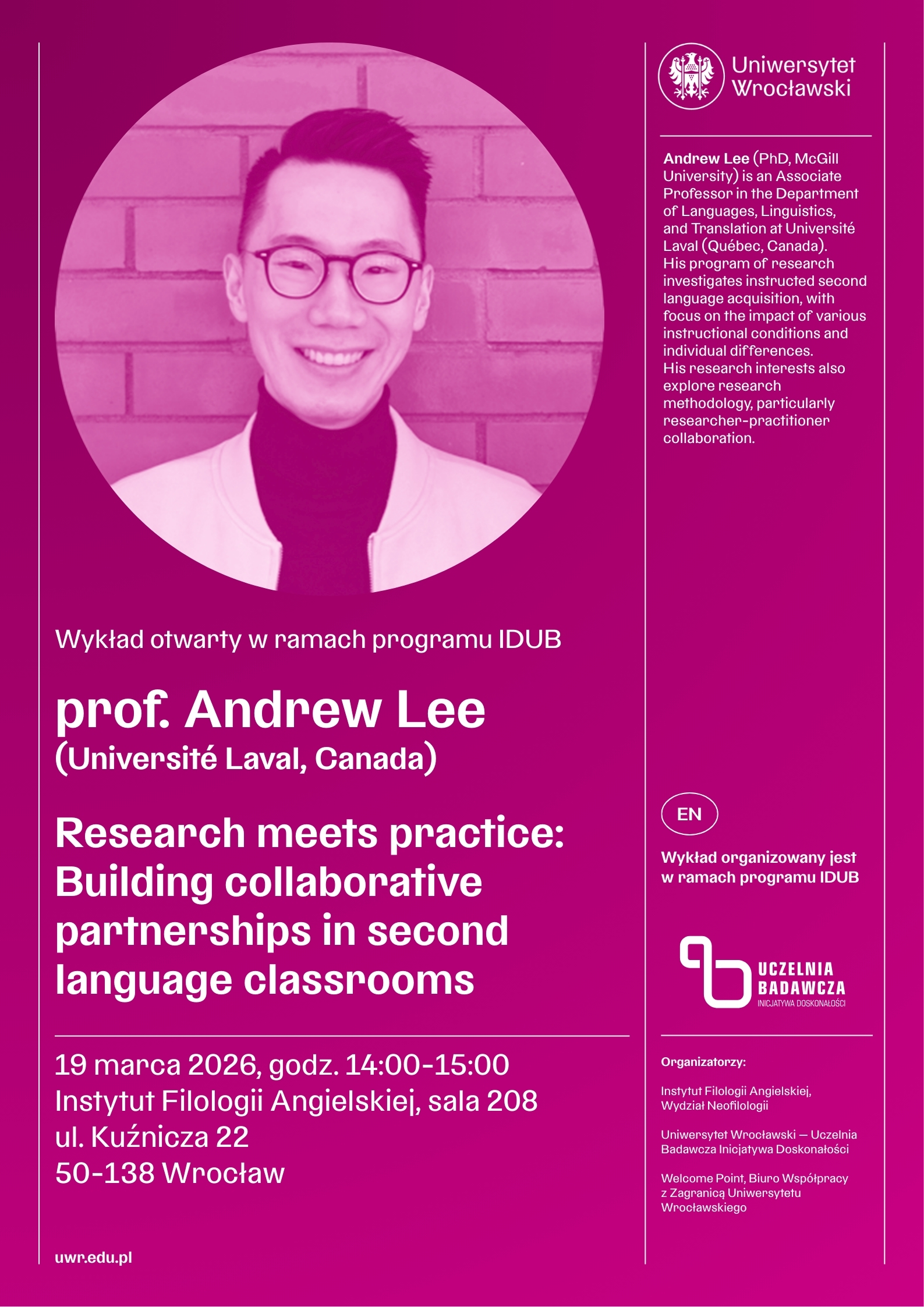
Prof. Andrew Lee, „Research meets practice: Building collaborative partnerships in second language classrooms„
Biuro projektu IDUB zaprasza na wykład: „Research meets practice: Building collaborative partnerships in second language classrooms” Profesora Andrew Lee (Université Laval, kanada)
19 marca 2026 r., godz. 14.00 – 15.00, Instytut Filologii Angielskiej, ul. Kuźnicza 22, sala 208
Abstrakt:
How can researchers and practitioners work together collaboratively in second language classrooms? In this public lecture, I address this timely question by examining the challenges of researcher-practitioner collaboration and proposing evidence-based solutions drawn from my recent researcher-industry partnership projects. Participants will gain insights into the significance of evidence-based second language teaching and learning, strategies for fostering mutually beneficial and sustainable collaborations, and a practical model of researcher-practitioner partnership that benefits all stakeholders in second language research and practice.
Notka bio:
Andrew Lee (PhD, McGill University) is an Associate Professor in the Department of Languages, Linguistics, and Translation at Université Laval (Québec, Canada). His program of research investigates instructed second language acquisition, with focus on the impact of various instructional conditions and individual differences. His research interests also explore research methodology, particularly researcher-practitioner collaboration.
Osoba odpowiedzialna: dr Małgorzata Baran-Łucarz, Instytut Filologii Angielskiej, Wydział Neofilologii UWr
Prof. Anna Finozzi, „Postcolonial Children’s Literature: The Italian Case„
Centrum Badań Literatury dla Dzieci i Młodzieży zaprasza na trzydziesty piąty wykład z serii „International Voices in Children’s Literature Studies”. Wykład prof. Anny Finozzi (University of Stockholm), pt. Postcolonial Children’s Literature: The Italian Case odbędzie się on-line 25 marca o godz. 19.00 (TEAMS)
Wszystkich zainteresowanych udziałem prosimy o kontakt za pomocą formularza: https://forms.office.com/e/hj6hxrshe2
Abstrakt: This lecture explores racial and gendered representations in Italian children’s literature through the analysis of a corpus of postcolonial texts, including picturebooks, graphic novels, silent books, and novels published in the last decade. The analysis is grounded in a diachronic framework that traces a trajectory from late nineteenth-century adventure narratives, through colonial and Fascist propaganda, to contemporary writing. Particular attention is given to texts by second-generation authors and how identity in their texts is negotiated through naming practices, spatial configurations, including border crossings and urban spaces, and complex chromatic vocabularies. Through this analysis, I situate Italian children’s literature within a wider European and postcolonial landscape, exploring how racial discourses have circulated, been reformulated, and normalized both through and beyond it.
Biogram: Anna Finozzi is a postdoctoral fellow in Italian literature at the Department of Romance Studies and Classics, University of Stockholm. Her areas of interest are Italian postcolonial studies, feminist and posthuman studies, and children’s literature. She has published articles in international journals and edited several volumes. Latest publications include: “About Pigs and Girls: A Posthuman Reading of Bianca Pitzorno’s Children’s Novel Polissena del Porcello (1993)” (Italian Studies) and “Studies, personaggi e letteratura italiana per l’infanzia: una ricognizione” (Narrativa). She is co-founder of ICONICs—Italian Collective of Narratives in Interdisciplinary Children’s Studies.
Organizatorzy z ramienia Centrum Badań Literatury dla Dzieci i Młodzieży: dr hab. Mateusz Świetlicki, prof. UWr (Instytut Filologii Angielskiej), dr Elżbieta Jamróz-Stolarska (Instytut Nauk o Informacji i Mediach), dr Bożena Hojka (Instytut Nauk o Informacji i Mediach)
Kwiecień
Dr Dominik Kudła, „GenAI w lokalizacji językowej gier wideo oraz postedycji„
Koło Naukowe Groznawców Fire Keepers zaprasza na kolejny wykład poświęcony badaniom nad grami wideo pt. genAI w lokalizacji językowej gier wideo oraz postedycji. Wykład odbędzie się 14 kwietnia 2026 r. o godz. 13:30 na platformie MS Teams.
Link do spotkania:
https://teams.microsoft.com/meet/31155192104436?p=NsHr6kca0RsZgZOiVB
Abstrakt:
Od ponad trzech lat technologie oparte na wielkich modelach językowych zmieniają sposób w jaki patrzymy na wszystkie obszary rynku usług tłumaczeniowych. Dotyczy to też lokalizacji językowej gier wideo, gdzie niezwykle istotnym elementem jest autentyczność wszystkich wersji językowych i wysoki nacisk na nie tylko odtwórczy, ale i twórczy element kreatywności tłumacza.
Część firm działających w branży lokalizacji chwali się opracowywaniem własnych modeli generatywnej sztucznej inteligencji (genAI), podczas gdy wielu tłumaczy jest wysoce niezadowolonych z czasochłonnej i frustrującej postedycji tłumaczenia korzystającego wyłącznie z genAI. Odczucia te wynikają z odtwórczości oraz dużej liczby nieścisłości językowych i merytorycznych znajdowanych w takich tłumaczeniach.
Podczas spotkania omówione zostaną najczęstsze sposoby wykorzystywania narzędzi genAI w tłumaczeniu, postedycji oraz innych elementach procesu lokalizacji językowej gier wideo. W świetle najnowszych badań zostaną przedstawione także możliwości, jakie rozwiązania tego typu mogą mieć w usprawnianiu tych procesów oraz jakie mogą być tego skutki dla użytkowników oraz branży lokalizacji językowej.
Biogram:
dr Dominik Kudła jest adiunktem w Instytucie Komunikacji Specjalistycznej i Interkulturowej (Wydział Lingwistyki Stosowanej) Uniwersytetu Warszawskiego, gdzie prowadzi zajęcia dotyczące różnorodnych tłumaczeń specjalistycznych oraz wielu aspektów specjalistycznego i ogólnego języka angielskiego, rosyjskiego i polskiego. Jego zainteresowania badawcze koncentrują się wokół lokalizacji językowej gier wideo i dydaktyki tłumaczenia. Ponadto interesuje się innymi zagadnieniami translatoryki, metodologią eyetrackingową, językiem sportu i zapożyczeniami językowymi. Od 2016 roku jest członkiem Laboratorium Eksperymentalnej Lingwistyki Okulograficznej na WLS UW (https://www.lelo.uw.edu.pl), gdzie prowadzi wiele badań dotyczących tłumaczenia pisemnego i ustnego oraz nauczania języków. Jest członkiem Rady Polskiego Towarzystwa Badania Gier (https://www.ptbg.org.pl/) oraz Rady Naukowej czasopisma naukowego „L10N Journal Translation in Software. Software in Translation” (https://l10njournal.net/). Pracuje również jako tłumacz między językiem polskim angielskim i rosyjskim i dąży do dialogu pomiędzy branżą tłumaczeniową i środowiskiem akademickim. Od 2018 roku organizuje na WLS UW cykl spotkań „Studenci lingwistyki stosowanej na rynku pracy”, które prezentują społeczności wydziału możliwe ścieżki kariery w trakcie i po zakończeniu studiów.
Organizacja wykładu: Adam Bilski, Instytut Filologii Angielskiej
Prof. Karol Sauerland, „Zagadka Zygmunta Łempickiego przed i po II wojnie światowej”
15 kwietnia o godz. 13.30 w Sali Nehringa, Instytut Filologii Polskiej, pl. Nankiera 15b.
Wykład w języku polskim
STRESZCZENIE
Tytułowa zagadka to między innymi pytanie o przyczyny, dla których myśl jednego z najbardziej inspirujących polskich literaturoznawców i filozofów kultury XX wieku, do dziś pozostaje obecna lepiej w obiegu międzynarodowym niż w kraju. Autor przenikliwych badań dotyczących romantyzmu, teorii literatury oraz językoznawstwa nie doczekał się jeszcze spójnego ujęcia swoich poglądów. Wykład eksperta od półwiecza badającego dzieło Zygmunta Łempickiego (1886-1943) przybliży również powojenne losy piśmiennictwa zmarłego w Auschwitz germanisty, docierającego do czytelników niezmiennie nieoczekiwanymi drogami. Szczególny nacisk położony będzie na białe plamy w biografii naukowej warszawskiego filologa doby międzywojennej.
BIOGRAM
Prof. dr hab. Karol Sauerland – polski germanista, historyk idei oraz tłumacz, specjalizujący się w filozofii niemieckiej i relacjach polsko-niemieckich urodzony w Moskwie. Ze względów politycznych musiał przerwać studia filozoficzne na Uniwersytecie Humboldta w Berlinie, następnie studiował matematykę i germanistykę. Przez wiele lat związany był z Uniwersytetem Warszawskim, gdzie prowadził badania nad myślą oświeceniową, romantyzmem oraz recepcją kultury niemieckiej w Polsce. Autor licznych prac naukowych dotyczących m.in. Immanuela Kanta, Johanna Gottfrieda Herdera, Theodora Adorno i tradycji humanistycznej Europy. Jego działalność obejmuje również przekłady tekstów filozoficznych oraz aktywne uczestnictwo w dialogu intelektualnym między Polską a Niemcami. Kierował Zakładem Literaturoznawstwa przy Instytucie Germanistyki UW (1977-2005) i Katedrą Germanistyki UMK (1979-86, 1990-2006). Nagrodzony Nagrodą im. Petöfiego (2015).
Publikacje: https://sauerland.pl/txt/ausgewahlte
Osoby do kontaktu: Krzysztof Żarski, Jan Krzywdziński (jan.krzywdzinski@uwr.edu.pl)
Prof. Yasmine Motawy, „Narrating the Nation: Navigating Neoliberal Spaces in the New Wave of Egyptian Children’s Literature„
Centrum Badań Literatury dla Dzieci i Młodzieży zaprasza na trzydziesty szósty wykład z serii „International Voices in Children’s Literature Studies”. Wykład Prof. Yasmine Motawy (The American University in Cairo), pt. Narrating the Nation: Navigating Neoliberal Spaces in the New Wave of Egyptian Children’s Literature odbędzie się on-line 20 kwietnia o godz. 18.00 (TEAMS)
Wszystkich zainteresowanych udziałem prosimy o kontakt za pomocą formularza: https://forms.office.com/e/KAx6Kh0ksr
Abstrakt po angielsku: In this talk, Yasmine Motawy draws on her new book, Children’s Picture Books and Contemporary Egyptian Society, which examines a new wave of Egyptian picture books published since the early 2000s to explore how neoliberal policies in Egypt are narrated in children’s books, shaping how the nation is imagined. Contextualizing the development of Egyptian children’s literature against a backdrop of socioeconomic neoliberal policies with wide cultural impact, the talk considers how some of these books translate neoliberal aspirations, particularly surrounding the use of public, domestic, and urban spaces, as well as non-spaces, to young readers.
Bio po angielsku: Yasmine Motawy is a scholar, critic, translator, editor, and consultant specializing in children’s literature. She has served on major regional and international award juries, including the 2021 Bologna Ragazzi Award, the 2016 and 2018 Hans Christian Andersen Award, the 2017 Etisalat Award for Arabic Children’s Literature, and chaired the 2025 Sawiris Cultural Award. She co-edited The Routledge Companion to International Children’s Literature (2018). In 2022, she received AUC’s Excellence in Research and Creative Endeavors Award. Her latest book is Children’s Picture Books and Contemporary Egyptian Society (2025). She currently serves on the board of the International Research Society for Children’s Literature (2025–2027).
Organizatorzy z ramienia Centrum Badań Literatury dla Dzieci i Młodzieży: dr hab. Mateusz Świetlicki, prof. UWr (Instytut Filologii Angielskiej), dr Elżbieta Jamróz-Stolarska (Instytut Nauk o Informacji i Mediach), dr Bożena Hojka (Instytut Nauk o Informacji i Mediach)
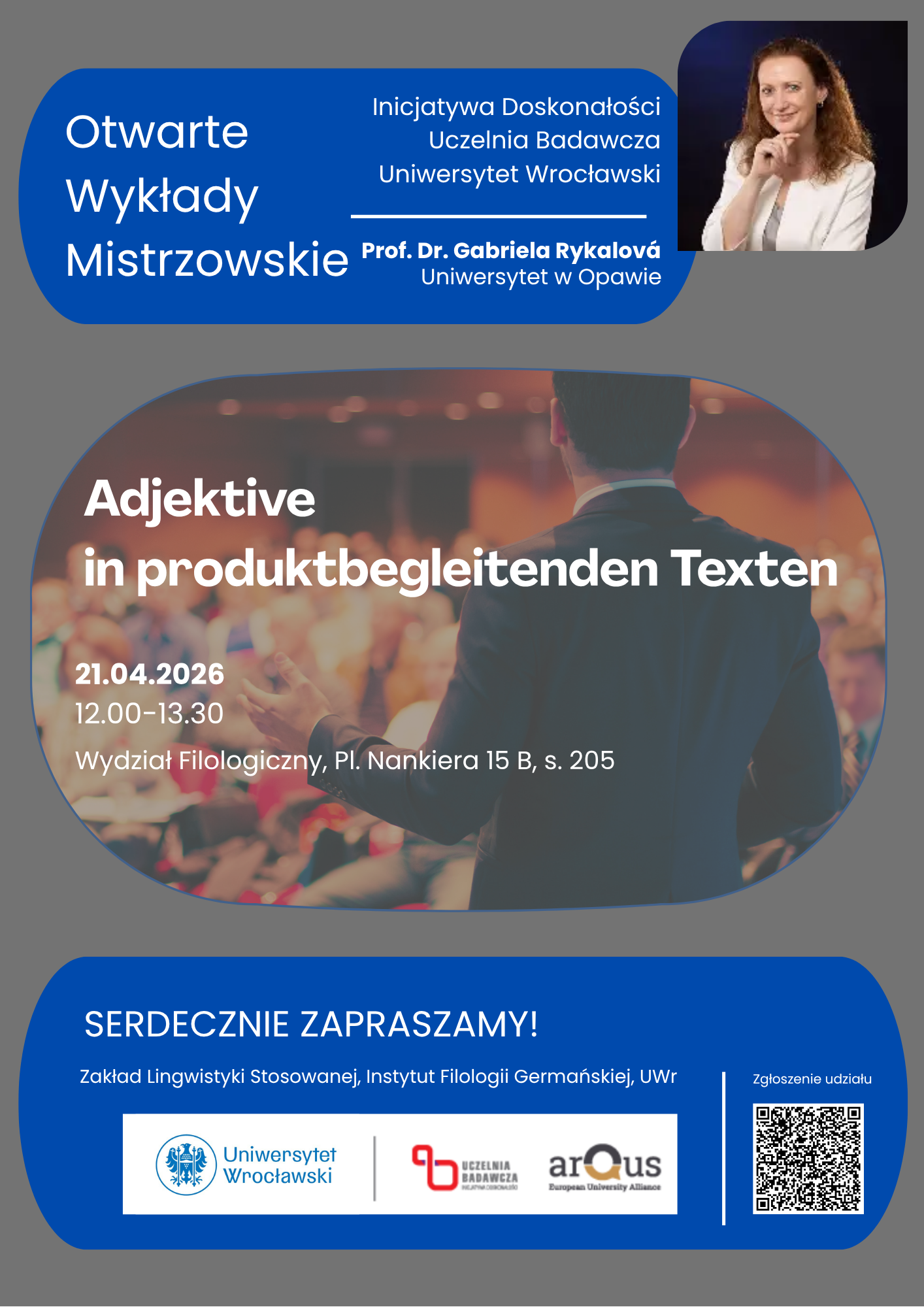
Prof. Dr. Gabriela Rykalová, „ Adjektive in produktbegleitenden Texten”
Zakład Lingwistyki Stosowanej w Instytucie Filologii Germańskiej UWr zaprasza na wykład realizowany w ramach profesury gościnnej IDUB.
21.04.2026, 12.00-13.30, IFG, Pl. Nankiera 15 B, s. 205
Język wykładu – język niemiecki
Forma – hybrydowa
Abstract
Przymiotniki odgrywają kluczową rolę w tekstach towarzyszących produktom, takich jak opisy, etykiety czy materiały marketingowe. Ich podstawową funkcją jest nie tylko precyzyjne określenie cech produktu, lecz także budowanie jego atrakcyjnego wizerunku oraz wpływanie na decyzje zakupowe konsumentów. Często stosowane są przymiotniki o pozytywnym nacechowaniu emocjonalnym, które mają na celu wzbudzenie zainteresowania i zaufania odbiorcy. Jednocześnie obserwuje się tendencję do używania form intensyfikujących, takich jak stopniowanie czy przysłówki wzmacniające, co prowadzi do subiektywizacji przekazu. Analiza użycia przymiotników w tego typu tekstach pozwala lepiej zrozumieć strategie perswazyjne stosowane w komunikacji marketingowej oraz ich wpływ na percepcję produktu przez konsumenta.
Biogram
Prof. dr Gabriela Rykalová jest czeską językoznawczynią i germanistką, od 1999 roku zatrudnioną na Uniwersytecie Śląskim w Opawie, gdzie pełni funkcję docentki w zakresie filologii niemieckiej. Od 2019 roku jest prodziekanem ds. nauki i współpracy międzynarodowej, a od 2008 roku kieruje katedrą germanistyki. Specjalizuje się w lingwistyce tekstu, stylistyce, języku mediów, lingwistyce kontrastywnej oraz badaniach nad językami specjalistycznymi. Jej zainteresowania naukowe obejmują m.in. analizę tekstu oraz funkcjonowanie przymiotników w różnych typach dyskursu. Autorka licznych publikacji naukowych, w tym monografii poświęconej niemieckiemu imiesłowowi. Stopień doktora uzyskała w 2008 roku na Uniwersytecie Śląskim w Opawie, a habilitację w 2015 roku na Uniwersytecie w Ostrawie. Była również wielokrotnie profesorem wizytującym na Uniwersytecie Juliusza i Maksymiliana w Würzburgu.
Kontakt: Prof. dr hab. Joanna Szczęk (joanna.szczek@uwr.edu.pl)
Prof. Snizhana Holyk, „Growing Old in Stories: Representations of Ageing in Children’s Literature”
Centrum Badań Literatury dla Dzieci i Młodzieży i Instytut Filologii Angielskiej zapraszają na wykład Prof. Snizhany Holyk (Uzhhorod National University), pt. „Growing Old in Stories: Representations of Ageing in Children’s Literature”, który odbędzie się stacjonarnie 23 kwietnia o godz. 14:00. Miejsce: Instytut Filologii Angielskiej, sala 11.
Tytuł: Growing Old in Stories: Representations of Ageing in Children’s Literature
Bio po angielsku: Dr. Snizhana Holyk is an Associate Professor and Head of the English Philology Department at Uzhhorod National University, Ukraine. Her research interests include cultural linguistics, ageing studies, and cognitive linguistics, with a particular focus on the conceptualisation of old age. She has published widely on the representation of old age in language and media, including recent works Cultural Conceptualization of Old Age in English in Cultural Linguistics and the Social World (Springer, 2024), and Constructing Old Age: How Newspapers Use Bias and Persuasion to Shape the Aging Discourse published in Revue Internationale Animation, Territoires et Pratiques Socioculturelles (2025).
Abstrakt po angielsku: What do children learn about ageing long before they grow old?
While societies increasingly grapple with the implications of longer life expectancy, far less attention has been paid to how ideas about ageing are formed in early childhood. This lecture explores how children’s literature, particularly picturebooks, shapes young readers’ perceptions of old age through both language and imagery.
Drawing on discourse analysis and ageing studies, it reveals how older adults are often marginalised, underrepresented, or confined to stereotypical roles, reinforcing the narratives of decline and dependency. At the same time, the lecture highlights the transformative potential of children’s literature as a cultural space where such assumptions can be challenged. By examining the dynamic interplay between visual and verbal elements, it demonstrates how picturebooks can foster empathy, encourage intergenerational understanding, and promote more inclusive and empowering visions of later life.
Furthermore, the lecture invites us to reconsider children’s literature not merely as a reflection of societal attitudes toward ageing, but as a powerful site where these attitudes are actively constructed, and where they can be reimagined.
Organizatorzy: dr hab. Mateusz Świetlicki, prof. UWr (Instytut Filologii Angielskiej), dr Elżbieta Jamróz-Stolarska (Instytut Nauk o Informacji i Mediach)
Prof. Teresa Tomaszkiewicz, „Tłumaczenie intersemiotyczne kiedyś i dziś„
Centrum Badań Kognitywnych nad Językiem i Komunikacją zaprasza w najbliższy czwartek, 23 kwietnia o godz. 18:00, na wykład Pani Profesor Teresy Tomaszkiewicz (UAM Poznań). Wystąpienie będzie dotyczyć problematyki tłumaczenia intersemiotycznego i jego współczesnych ujęć.
Wydarzenie odbędzie się online (MS Teams) w języku polskim. Oto link do spotkania:
Wykład prof. Teresy Tomaszkiewicz dla CBKJK | Dołączanie do spotkania | Microsoft Teams
Abstrakt:
Tłumaczenie intersemiotyczne kiedyś i dziś
W niniejszym wystąpieniu podejmuję problematykę tłumaczenia intersemiotycznego, obecnego w refleksji językoznawczej i przekładoznawczej od 1957 roku, tj. od publikacji artykułu Roman Jakobson On Linguistic Aspects of Translation (w: R. Brower (red.), On Translation, Harvard University Press). Współcześnie zagadnienie to ponownie zyskuje na znaczeniu, co wiąże się z rosnącą rolą elementów niejęzykowych w komunikacji oraz – w konsekwencji – w procesach translacyjnych.
Na różnych etapach rozwoju językoznawstwa, a zwłaszcza przekładoznawstwa, pojęcie tłumaczenia intersemiotycznego było interpretowane w sposób niejednorodny, często odbiegający od pierwotnych intencji jego autora. Celem wystąpienia jest zatem, po pierwsze, prześledzenie ewolucji tego pojęcia oraz wskazanie trudności związanych z jego definiowaniem. Po drugie, proponuję wprowadzenie do debaty kategorii „obrazu”, nieobecnej explicite u Jakobsona, a dziś kluczowej dla adekwatnego opisu i rozumienia tłumaczenia intersemiotycznego.
Po trzecie, analizie poddane zostaną teksty współwystępujące z obrazami, w celu uchwycenia relacji między nimi oraz ich wpływu na konstruowanie sensu podlegającego tłumaczeniu. Wreszcie, rozważona zostanie kwestia przekładu komunikatów wizualnych na werbalne: czy wszystkie tego typu transformacje mieszczą się jeszcze w obrębie Jakobsonowskiego pojęcia tłumaczenia intersemiotycznego? Odpowiedź na to pytanie stanowi zasadniczy punkt odniesienia dla proponowanej dyskusji.
Biogram:
Prof. dr hab. Teresa Tomaszkiewicz (Wydział Neofilologii, UAM, Poznań), językoznawczyni, profesor w Zakładzie Traduktologii i Badań nad Kanadą Frankofońską. Teresa Tomaszkiewicz jest specjalistką w zakresie językoznawstwa porównawczego i romańskiego, komunikacji medialnej, przekładoznawstwa oraz semiologii porównawczej. Od 2019 roku jest członkinią Rady Doskonałości Naukowej w dyscyplinie językoznawstwo. Za działalność naukową i organizacyjną została odznaczona Krzyżem Kawalerskim Orderu Odrodzenia Polski (2013).
Osoba odpowiedzialna za wykład: prof. dr hab. Marek Kuźniak
Maj
Dr Michał Ptaszyński, „Beyond English: How Language Similarity Predicts the Performance of Multilingual AI „
Zakład Lingwistyki Korpusowej zaprasza na wykład mistrzowski dr. Michała Ptaszyńskiego (Kitami Institute of Technology) o tytule: Beyond English: How Language Similarity Predicts the Performance of Multilingual AI.
Wykład odbędzie się 7 maja 2026 roku o 10.00 zdalnie za pośrednictwem aplikacji MS Teams.
Formularz z listą obecności: https://forms.office.com/e/vTdk7rt97X
Link do spotkania: https://teams.microsoft.com/meet/32209157648461?p=abKzGlHGkyJCA27Dwy
Abstrakt
When building AI tools for new or low-resource languages, developers usually default to training their models on English. However, this intuitive approach often leads to sub-optimal results. In this lecture, I will explore why linguistic similarity is the true key to unlocking successful cross-lingual AI.
I will introduce qWALS, a novel metric that calculates the grammatical, phonological, and semantic proximity between over 2,500 languages. By evaluating multilingual transformers across diverse NLP tasks, I will demonstrate how choosing a similar source language drastically improves zero-shot model performance compared to simply using English.
I will propose the idea that in multilingual tasks language models behave as polyglots, by exploiting knowledge from other languages.
The proposed qWALS language similarity score is a data-driven framework for building more effective and equitable multilingual technologies.
Wykład będzie prowadzony w języku polskim.
Biogram
Michał Ptaszynski received the master’s degree from the University of Adam Mickiewicz, Poznan, Poland, in 2006, and the Ph.D. degree in information science and technology from Hokkaido University, Japan, in 2010. From 2010 to 2012, he was a JSPS Postdoctoral Research Fellow with the High-Tech Research Center, Hokkai-Gakuen University, Japan. Later, he joined Kitami Institute of Technology, as Assistant Professor, then Associate Professor. Currently, he is a Full Professor with Kitami Institute of Technology. He is the founder of the fields of Automatic Cyberbullying Detection and Ainu Language Processing. His research interests include artificial intelligence, and natural language processing, especially of low-resource, indigenous, and endangered langauges. He is a member of AAAI and ACL, and a Senior Member of IEEE.
Osoba odpowiedzialna za wykład: prof. Monika Zaśko-Zielińska
Wszystkie pytania w sprawie wykładu prosimy kierować na adres: corpus@uwr.edu.pl
Dr hab. Michał Kłosiński, profesor UŚ, „Ludyczne negacje życia, o thanato- i nekro- polityce w grach cyfrowych”
Koło Naukowe Groznawców Fire Keepers przedstawia kolejną propozycję wykładu mistrzowskiego pt. Ludyczne negacje życia, o thanato- i nekro- polityce w grach cyfrowych.
Wykład odbędzie się 8 maja 2026 r. o godz. 09:30 na platformie MS Teams.
Link do spotkania:
https://teams.microsoft.com/meet/388627930901055?p=FTLuXlUkSdcIkdZrwY
Abstrakt:
W Diunie Franka Herberta znajduję jedno z najprostszych założeń, na których opiera się negacja życia: “He who can destroy a thing has the real control of it” pisze Herbert (1981, s. 446). Trudniej w kulturze współczesnej znaleźć inne medium, w którym decyzja o zniszczeniu życia, a zatem i jego kontroli, byłaby w łatwiejszy sposób oferowana, przyjemna i pozytywnie uzasadniona niż w grach cyfrowych. Studia groznawcze mierzą się z tym fenomenem z oczywistych względów. Wszak oddanie sprawczości i uczynienie z eksterminacji nieskończonej rzeszy fotorealistycznych wrogów rozkoszy ludycznej przyprawiają niektórych o gęsią skórkę. W moich badaniach nad tym, jak gry mediują rządzenie życiem, interesuje mnie, między innymi, opisanie i analiza różnych wzorców negacji życia, które oferują nam w ramach wielu styli i gatunków rozgrywki gry cyfrowe. W tym wystąpieniu stawiam zatem pytanie o różne ujęcia i filozoficzne podstawy dla refleksji o negacji życia: od Foucaulta, przez Agambena, po Mbembe. Następnie interesuje mnie to, jak gry realizują kwestie związane z eksterminacją, rasizmem, tanatopolityką oraz nekrowładzą. Na przykładzie trzech tytułów: Plague Inc: Evolved, Helldivers 2 oraz Arc Raiders przedstawię różne paradygmaty negacji życia w grach cyfrowych i postaram się odpowiedzieć na pytanie, o to, co czyni z nich tak przyjemne i rozkoszne doświadczenia.
Biogram:
Dr hab. Michał Kłosiński, profesor UŚ, dyrektor Centrum Badań Groznawczych, członek sieci naukowych badań nad grami (DiGRA), przeciwdziałania ekstremizmowi w grach (GEMS) oraz utopiami (USS, SUS). Absolwent Paris Program in Critical Theory, autor monografii poświęconych teorii literatury (2013, 2015), analizie i interpretacji gier cyfrowych: Przygody cyfrowego tułacza (2023) oraz badaniom nad growymi utopiami i dystopiami: Hermeneutyka gier wideo (2018). Współredagował książki poświęcone badaniom ekonomii literatury (2016), utopii (2016) oraz dyskursów gier cyfrowych (2019). Publikował artykuły w czasopismach groznawczych Game Studies, Games and Culture, Journal of Gaming in Virtual Worlds, oraz literaturoznawczych Teksty Drugie, Pamiętnik Literacki, Przestrzenie Teorii, Zagadnienia Rodzajów Literackich. Michał łączy refleksję filozoficzną z rozważaniami narratologicznymi na przecięciu pól badawczych game studies oraz utopian studies. Od 2022 roku prowadzi badania nad biopolityką gier, czyli problemami zarządzania życiem w grach i przy pomocy gier.
Organizacja wykładu: Adam Bilski, Instytut Filologii Angielskiej
Dr Elżbieta Zarych, „Porozmawiajmy o ilustracji. Wokół książki Kwiaty, dziewice i upiory. „Ballady i romanse” Adama Mickiewicza w ilustracjach„
Pracownia Badań nad Związkami Słowa i Obrazu w Praktykach Piśmiennych zaprasza na wykład dr Elżbiety Zarych: Porozmawiajmy o ilustracji. Wokół książki Kwiaty, dziewice i upiory. „Ballady i romanse” Adama Mickiewicza w ilustracjach.
Data i miejsce wykładu: 14 maja 2026, 12.00, Instytut Filologii Polskiej, sala 125
Abstrakt: Inspiracją spotkania i wykładu jest tom Kwiaty, dziewice i upiory. „Ballady i romanse” Adama Mickiewicza w ilustracjach Elżbiety Zarych, opublikowany nakładem wydawnictwa słowo/obraz terytoria (2025). Zbiór Adama Mickiewicza zajmuje szczególną pozycję w polskiej literaturze i kulturze, obecny jest też w rodzimej edukacji i na rynku wydawniczym nieprzerwanie od 200 lat. Od samych początków rozwoju książki ilustrowanej w Polsce do dziś ukazało się też kilkadziesiąt edycji ilustrowanych cyklu, pojedynczych utworów oraz rozmaitych wyborów ballad i romansów. Ilustratorzy różnych epok, sięgając po teksty Mickiewicza, ukazują je w odmienny sposób, a edycje te wydawane bywają z rozmaitych powodów i okazji oraz dla różnych odbiorców. I cykl, i pojedyncze utwory stanowią więc doskonały materiał do przyjrzenia się licznym zagadnieniom związanym z ilustracją, relacją słowa i obrazu, rodzimym rynkiem książki, czynnikami rzutującymi na kształt publikacji, politycznymi i społecznymi uwarunkowaniami kształtu edytorskiego oraz artystycznego itd. Realizacje udane i sytujące się na granicy kiczu, zachwycające, zaskakujące, rozczarowujące… prowadzą do licznych pytań o kwestie wpływające na wizualizację, interpretację i reinterpretację tekstów, a także o odbiór, oddziaływanie ilustracji na czytelników oraz umiejętność czytania obrazów. Ballady i romanse są lustrem, w którym odbijają się ostatnie dwa wieki historii polskiej książki i ilustratorstwa, a bogaty w przykłady tom poświęcony dziełu zachęca do tego, by porozmawiać o ilustracji, o jej teorii i praktyce.
Biogram: Elżbieta Zarych – doktor nauk humanistycznych, literaturoznawczyni, komparatystka, polonistka, redaktorka, tłumaczka literatury niemieckiej i włoskiej, recenzentka. Od wielu lat związana z Uniwersytetem Jagiellońskim, a także z licznymi wydawnictwami i instytucjami kultury. Obecnie pracuje na Wydziale Filologicznym UJ (w projekcie flagowym DiHeLib poświęconym badaniom nad Kolekcją Autografów z zasobu tzw. Berlinki) oraz w Instytucie Książki w Krakowie.Autorka wielu prac poświęconych literaturze i kulturze (zwłaszcza romantyzmowi polskiemu i niemieckiemu), pozycji edukacyjnych, leksykonów i słowników, a także beletrystyki, w tym baśni literackich. Najnowsze książki to tom Kwiaty, dziewice i upiory. Ballady i romanse Adama Mickiewicza w ilustracjach (2025) oraz wydane w serii naukowej „Czarny Romantyzm” dwie monografie baśni Ludwiga Tiecka (2020) i Josepha von Eichendorffa (2022) z własnym przekładem omawianych utworów. Przetłumaczyła około 50 książek z języków niemieckiego i włoskiego, ostatnio – Franz Kafka. Rysunki, pod redakcją Andreasa Kilchera (2023). Ma różnorodne i szerokie zainteresowania, w których centrum znajdują się wyobraźnia, ilustracja, książka i język.
Osoba odpowiedzialna ze strony organizatora: Dorota Ucherek, dorota.ucherek@uwr.edu.pl, Instytut Filologii Polskiej
Prof. Aline Frederico, „Researching digital literature for children: from innovation to preservation”
Centrum Badań Literatury dla Dzieci i Młodzieży zaprasza na trzydziesty siódmy wykład z serii „International Voices in Children’s Literature Studies”. Wykład Prof. Aline Frederico (University of São Paulo), pt. „Researching digital literature for children: from innovation to preservation” odbędzie się on-line 18 maja o godz. 19.00 (TEAMS)
Wszystkich zainteresowanych udziałem prosimy o kontakt za pomocą formularza: https://forms.office.com/Pages/ResponsePage.aspx?id=-b5xKxM7MkS19B9awieNDBoL9lKv119As1PU82Xrd8tUQkZOOE1ETE5YOFJBVFZHS0w1QVExWUJPVi4u
Abstrakt po angielsku: The tablet and smartphone era gave rise to the literary app, a new format for the creation of digital literature for children that flourished in the early 2010s. This technology enabled new forms of literary and artistic expression, fostering new experiences of agency and participation in reading and expanding the multimodality of the picturebook into full multimedia experiences. It also generated important research on these new forms of children’s literature, their possibilities, aesthetics, and reading experiences. Around fifteen years later, however, new works of digital children’s literature have become scarce. Many award-winning apps are no longer available, and many are inaccessible even for research purposes. In this lecture, I will reflect on my journey as a scholar of digital children’s literature over the past fifteen years, presenting an overview of the field that leads to my current preservation project DigitaLIJ, which maps, catalogues, and creates recordings of the past three decades of Brazilian digital children’s literature.
Bio po angielsku: Aline Frederico is an assistant professor at the School of Communications and Arts, University of São Paulo, where she works in the fields of children’s literature and publishing, with a focus on digital children’s literature. She holds a PhD from the University of Cambridge, completed postdoctoral research at Pontifical Catholic University of São Paulo, and earned a master’s degree from the University of British Columbia. She is co-editor of the book Literatura Digital para Crianças e Jovens: Teoria e Prática da Experiência Estética (Digital Literature for Children and young People: Theory and Practice of an Aesthetic Experience) and coordinates the DigitaLIJ project, dedicated to mapping Brazilian digital children’s literature. She is also a member of the editorial team of Antologia Lit(e)Lat Vol. 2, a digital antology focused on Latin American digital literature.
Organizatorzy z ramienia Centrum Badań Literatury dla Dzieci i Młodzieży: dr hab. Mateusz Świetlicki, prof. UWr (Instytut Filologii Angielskiej), dr Elżbieta Jamróz-Stolarska (Instytut Nauk o Informacji i Mediach), dr Bożena Hojka (Instytut Nauk o Informacji i Mediach)
Dr hab. Tomasz Ewertowski, „Polskie piśmiennictwo podróżnicze o Chinach, 1720–1949 – kulturowe splątania w perspektywie biograficznej”
Zakład Historii Literatury Romantyzmu Instytutu Filologii Polskiej zaprasza na wykład dr. hab. Tomasza Ewertowskiego (Szanghajski Uniwersytet Studiów Międzynarodowych) o tytule „Polskie piśmiennictwo podróżnicze o Chinach, 1720–1949 – kulturowe splątania w perspektywie biograficznej”
Wydarzenie odbędzie się 22.05.2026; godz.: 10.00 online (MS Teams) w języku polskim.
Link do spotkania:
Abstrakt: Wykład przedstawia przegląd biografii oraz tekstów polskich podróżników dotyczących Chin od końca XVIII wieku do roku 1949. Omawiając różne typy podróży oraz rozmaite konwencje literackie wykorzystywane do ich opisu, chciałbym przeanalizować, w jaki sposób podróżnicy przedstawiali Chiny, ukazać społeczny, polityczny i intelektualny kontekst kształtujący te reprezentacje oraz omówić czynniki wpływające na ich pisarstwo. Korpus źródeł obejmuje relacje ponad 60 autorów, wśród których znajdują się dyplomaci, misjonarze, dziennikarze, żołnierze, uchodźcy i turyści. Są wśród nich generał armii rosyjskiej badający zachodnie peryferie Chin, pionier polskiej sinologii podróżujący po południowo-zachodnich Chinach w latach trzydziestych XX wieku, chłop wcielony do armii rosyjskiej podczas wojny rosyjsko-japońskiej, pilot walczący przeciwko Japończykom podczas II wojny światowej i inni. Refleksja nad ich biografiami i tekstami skłania do stawiania pytań o powiązania między odległymi narodami, o czynniki wpływające na takie relacje – takie jak idee rasy, nowoczesności i mobilności – oraz o rolę studiów kulturowych i literackich w ich badaniu.
Biogram: Tomasz Ewertowski, dr hab., jest wykładowcą na Szanghajskim Uniwersytecie Studiów Międzynarodowych w Chinach. Ukończył Uniwersytet im. Adama Mickiewicza w Poznaniu. Jego zainteresowania naukowe obejmują podróżopisarstwo, komparatystykę, postkolonializm. Był kierownikiem dwóch grantów finansowanych przez polskie Narodowe Centrum Nauki. Jego publikacje obejmują monografię Images of China in Polish and Serbian Travel Writings (Brill, 2020), tom zbiorowy Transport Revolution and Travels to Asia, 1860s–1920s (Routledge, 2025) oraz artykuły w czasopismach takich jak Studies in Travel Writing, Journal of Historical Geography, Mobilities, Indonesia and the Malay World I innych. Jest redaktorem serii Anthem Studies in Encounters between Peripheral Regions oraz członkiem redakcji czasopisma Journal of Travel Literature Studies.
Organizacja wykładu: Wiktoria Konopka-Wilk
Dr hab. Dobrawa Lisak, „Literatura polska i formy pamięci o dźwiękach II wojny światowej„
Doktoranckie Koło Naukowe Kulturowych Teorii Współczesnej Humanistyki UWr oraz studenckie Koło Naukowe Młodej Krytyki UWr zaprasza na wykład dr hab. Dobrawy Lisak, organizowany w ramach 3. ogólnopolskiej konferencji naukowej „U(ś)cisk teraźniejszości. Kulturowe relacje teraźniejszości z przeszłością”.
Tytuł: Literatura polska i formy pamięci o dźwiękach II wojny światowej
Data i miejsce wykładu: 28 maja 2026 r., 10:00, Instytut Filologii Polskiej UWr, sala 125
Abstrakt: Pamięć dźwiękowa – zarówno indywidualna, jak i kolektywna – to fenomen, który w ostatnich latach przyciągnął uwagę wielu badaczy. Wykład stanie się okazją do przybliżenia różnych teorii na temat związków między pamięcią a zjawiskami audialnymi, a także do wyjaśnienia, na jakich zasadach tekst literacki może funkcjonować jako medium pamięci dźwiękowej. Materiałem, który zostanie poddany głębszej analizie, będzie polska literatura dotycząca odgłosów II wojny światowej, przywołująca wiele intensywnych, często awersyjnych wrażeń słuchowych. Ten obszar piśmiennictwa należy rozpatrywać nie tylko w kluczu chronologicznym, nakazującym odróżniać literaturę czasu wojny i okupacji od literatury powojennej w jej kolejnych odsłonach. Dodatkowo trzeba wziąć pod uwagę różnice w inscenizowaniu dźwięków wojny przez bezpośrednich świadków (piszących w latach 1939–1945 lub w okresie późniejszym), ich potomków („drugie pokolenie”) i kolejną generację („trzecie pokolenie”). Takie podejście otwiera drogę do rozważania związków literatury z traumą akustyczną, „ranami dźwiękowymi”, posttraumą, postpamięcią oraz pamięcią protetyczną, która zapożycza ponadnarodowe „ikony dźwiękowe” z kultury popularnej.
Biogram wykładowczyni: Dr hab. Dobrawa Lisak interesuje się literaturą polską XX i XXI wieku, intermedialnością, sound studies i literaturą traktowaną jako medium pamięci zbiorowej. Ukończyła studia kulturoznawcze i polonistyczne na Uniwersytecie Wrocławskim. W 2014 roku uzyskała tytuł doktora. Od 2015 roku pracuje w Instytucie Filologii Polskiej UWr, gdzie od 2025 roku pełni funkcję Zastępczyni Dyrektora ds. naukowych. Jest autorką trzech monografii: Ultraliteratura. O strategiach transmedialnych i poszukiwaniu pozawerbalnego we współczesnej literaturze polskiej (2014), Wizualne odskocznie. Wokół współczesnej polskiej eseistyki o malarstwie i fotografii (2016) oraz Poetycka tanatosonika. Dźwięki przemocy zbrojnej w wierszach z lat 1939–1945 (2025; tom stał się podstawą nadania jej tytułu doktora habilitowanego w marcu 2026 roku). W 2025 roku wydawnictwo Routledge opublikowało książkę, której jest współautorką: Czech and Polish Sound Memories of the Second World War: Museums, Literature, Sound Art.Artykuły naukowe jej autorstwa ukazały się m.in. w „Holocaust and Genocide Studies”, „Orbis Litterarum”, „Tekstach Drugich” i „Pamiętniku Literackim”.
Osoba odpowiedzialna ze strony organizatora: Julia Iwanicka, julia.iwanicka2@uwr.edu.pl, przewodnicząca ds. marketingowych Koła Naukowego Kulturowych Teorii Współczesnej Humanistyki UWr; Zakład Teorii Literatury, Instytut Filologii Polskiej UWr.